Monday, 23 January 2023

Discovering the world one molecule at a time: 42 scientists on a metabolomics adventure


DEEP PURPLE PhD student Elisa Peter has written a blog post for the European Association of Geochemistry, reporting back on her experience attending the EMBO Practical Course on Metabolomics Bioinformatics for Life Scientists in Wageningen, the Netherlands:

https://blog.eag.eu.com/news/discovering-the-world-one-molecule-at-a-time-42-scientists-on-a-metabolomics-adventure/

Tuesday, 5 July 2022

Diversity in action

By Rey Mourot 

How going to the Greenland Ice Sheet to study glacier microbial communities, their impact, and their diversity … teaches us quite something about our own! 

“Do we have everything ?”

The kitchen is full of stuff as I’m making sandwiches for the day on the ice sheet. Gluten-free bread and lactose-free spread cheese for Helen; this amazing vegan-feta thing for Katie, cheese and all the crappy food that fuels my motivation daily … thanks god Liane eats pretty much everything. Sandwiches packed, and here we go. Helicopter, ice sheet.


Helen, our GFZ postdoc. Fascinated by eukaryotic algae, she’s the “culturing” part of our team – although, as she says, she’s not able to keep a pet plant alive 😊

While they dig snow pits, the American Katie gently pokes on Helen’s British/Scottish accent and they try to imitate each other. I’m coring in silence, enjoying that my French accent is not brought up in the conversation. Liane is a few meters upwards from us, collecting air and snow samples; as a “European citizen” as she likes to say, her accent is from everywhere and nowhere at the same time.
  

Liane, GFZ Professor and the PI on this trip. Here to supervise, keep us alive and sample aerosols; although not necessarily in that order. Picture by Katie Sipes.

And as it should be, there’s no fieldwork in Greenland without Greenlanders – and our helicopter pilot Pilu, from Sermeq Helicopters, who has seen it all and way too cool to describe, completes our joyful team of small human-ants on the ice. In-between the jokes, our little fieldwork is going smoothly.
 

A view of our office on June 4th. 

Although this year we are only dashing in and out of our field site, I remember our long camping fieldworks of the two past years as a founding experience when it comes to learning from others and about ourselves.

On the ice sheet, isolated from the world and our dear and otherwise ever-present web connections, we quickly get to know each other by sharing common scientific interests and goals, but also by building an everyday life together – cooking, cleaning, doing the dishes, securing the camp, informing one another about the new crevasses that can be spotted around, how to flush the most correctly our natural waste. Camp mood and closeness is important both for the productivity of our sampling and our survival; and we all quickly learn the needs and quirks of each of us that need to be fulfilled to keep each member of the team happy.

Our DP 2021 field camp after the mist suddenly fell on it … speaking about extreme environments.  

This one works in the evening but will be late at breakfast; this one’s mental health depends on a constant supply of hot chocolate, this one needs to snack regularly or their mood will suffer, this one need more access to the communications to the mainland at the moment, this one will take afternoon naps, this one gets cold faster. Although we are all self-preserving, it actually becomes part of the routine to check on each-other, especially in an extreme environment. After all, several studies indicates that mutualistic groups have a higher chance of survival than groups composed of individualistic members.

Katie, postdoc in bioinformatics, the Aarhus part of our team, swimming among the icebergs in the harbor – among many other crazy things she does daily.

We easily adapt to our important diversity by giving our members maybe not the exact same things; but rather, what they need so the team functions at best. I sometimes wonder why this kind of diversity just functions so well for us, but the fieldwork world is still barely able to make gears that are safe and practical to use for everybody, pants half the population wouldn’t need to put down to their knee by a shitty weather to pee, and just, in general, space for all that do not correspond to the dominant idea of the explorer. 

In this bright month of June, far away from those considerations, our little four-people team is working to perfection; flowing smoothly between our differences of tastes, cultures and rhythms, as we learn to know each other’s qualities and quirks.

And, of course, the real stars of our fieldworks … these aggregates of cells and minerals trapped under the snow layer since September, and that we managed to reach to study them! 


Monday, 4 July 2022

DEEP PURPLE post on Department of Environmental Science LinkedIn

Snow isn’t exactly welcome on this Arctic expedition. 

Last week, Martyn Tranter, Ate Jaarsma, Shunan Feng, and Lasse Twiggs Degn set off on their summer fieldwork – the first of 20 who will make the journey this season. Traveling up to the north of Greenland with a portable research base is no mean feat – they must transfer 10 tons of equipment by barge, and helicopter to set up camp on the ice. It’s not just laboratory facilities either - sleeping quarters, toilets, a kitchen, and power sources need to be in place to support the altogether two-month long stay on the ice.  

But setting up camp in the wrong place could be disastrous. Snow in this case can dangerously conceal deep crevasses in the ice, which can quickly grow with glacier movement. Finding snow on arrival means that the team have been on standby in Ilulissat for a few days, and are in good spirits while they wait for an improvement in conditions so they can set up camp safely. If this drone footage captured by Shunan Feng is anything to go by, then at least it’s not a bad place to wait! 

Once the camp is established, the group will start their investigations, collecting data and studying the biology and chemistry of the glacier surface, and how this can affect the darkening and melting of the ice as part of the Deep Purple project. Read more about Deep Purple on the project website here: https://lnkd.in/eAtYzHvc and follow them on Instagram for some more insights from the team https://lnkd.in/ejx8Xbup. Deep Purple is funded by the European Research Council (ERC).

The original post can be found at https://www.linkedin.com/posts/envs-au_drifting-through-ilulissat-no-audio-activity-6949626298927333376-_TRT 

Wednesday, 1 September 2021

From 100 to 50 and 50 to 100

by Alexandre Anesio

The previous blog by Liane G. Benning clearly described the journey of trying to put together a massive and ambitious fieldwork programme for the Deep Purple project, going from the microscopic scale to remote sensing information to demonstrate the impact of ice algae and other impurities on the darkening of the ice, their controls and dynamics. A bunch of names from the brave team will be mentioned here and you can learn more about the team members on our “team” page.

No doubts, we started in a very high mood. However, as team 1 (Principal Investigator Martyn Tranter, Lasse, Rey, Joe, Ian, Eva, Shunan, and Lou) started their journey from Denmark on the 1st of July and began the process of setting up the camp, they were hit by a number of obstacles. The weather was far worse than predicted, delaying helicopter trips to the ice camp from the lovely Greenlandic town of Qaqortoq (https://visitgreenland.com/da/destinationer/qaqortoq/). Corona just started to hit Greenland, which had faired very well until ca one week after we arrived. We had to separate our teams between vaccinated and non-vaccinated members of the group, reschedule the science programme and wait for good weather. The task of setting up a camp for ca 16 people at a time on the ice was more challenging than anticipated. Team 2 (myself, Marie, Ate, Frederik, Chris, Pamela and Leeds University beloved collaborator Jim McQuaid) arrived on the 8th  of July with half of team 1 still in Qaqortoq. It took five days before we were all on the ice, but we had to leave Martyn Tranter behind in Qaqortoq to serve as a very needed organizer and local fixer on the ground, securing communications between ice and civilization, sending of the samples back to Denmark/Germany, organising flights and all sorts of things (even buying 15 rain ponchos that turned out to be a quite nice addition to keep the team on the ice dry).

Deep Purple camp when it was at its max capacity. Photo Alex Anesio

Team 3 (Principal Investigator Liane G. Benning, Helen, Elisa, and Laura Perini) arrived on the 12th of July to Qaqortoq but only managed to get on the ice ca 5 days later since Qaqortoq went into lockdown. Meanwhile, Teams 1 and 2 had just experienced 52 mm of rain on the ice in a 24 h period. Within just one 1 h of Team 3’s arrival, another 47 mm of rain fell. Considering the conditions (both weather and corona uncertainty), Team 4 had to cancel their travel plans, but their science plans were re-distributed between us to ensure all science was carried out. This left us behind time-wise, but then a spell of good weather hit, and that, coupled with great spirits in the team and the desire to get a lot of work done, was just what we needed.

A massive transformation on the ice was now happening in front of our eyes with the ice algae blooming. The rain had seemed to wash microbial cells together with impurities, but a few days of dry weather in the middle of the summer darkened the ice at incredible speed. At this point, the camp was running like a watch; carnivores were eating like vegetarians, freezer, fridge and -80 degree freezer were getting full with samples, the solar panels were providing all the energy necessary to fuel all sorts of equipment, and our journalist and TV visitors managed to make it all the way to the ice sheet (no names mentioned yet ;-)). All this happened as we received news from the civilization that Greenland was having unprecedented amounts of rain and the IPCC report was released, demonstrating the urgency of more understanding of feedback mechanisms between different stressors and fueling the young scientists in the project with a clear sense of purpose.


First lot of -80 degree samples for omics and pigments arriving with teams 1 and 2.

Slowly, parts of Teams 1, 2 and 3 left this year’s field camp, having done their jobs brilliantly. On the 6th of August, I arguably had the most glorious day of my scientific life. The final team of six scientists (Lou, Shunan, Liane, Elisa, Laura P, and myself) and our field logistics whizz Lasse woke up to blue skies. As luck would have it, that day satellites were passing above our location and we had a full day collecting data from the microscopic scale to cm and then meters to make the full connection of what we see on the ground and what satellites  observe from the sky. The ice algae were in full bloom and the ice surface was full of very active ice algae. We walked about 20,000 steps, collecting pictures of the ice, spectral signatures and samples for all sorts of omics. Flights with the drone matching the satellite passing were also done. It was a tiring day that went on throughout the night, with additional midnight sampling to check how the ice algae behave when it is dark. Our luck continued during the few hours of darkness, as a rare event of northern lights put icing on the cake  ̶  what a fantastic day.

Left: Ice surface (tens of cm scale). Picture taken from 1.7 m distance from the ice. Photo Alex Anesio

Right: Ice surface picture taken with a handheld microscope (mm scale). The pigmented ice algae is very abundant on the ice (example of a filamentous algae shown by the arrow), which essentially explains a lot of the darkening of the ice. As the ice becomes darker, more melting occurs. Photo Alex Anesio

After that, it was time to start the long process of decamping. Not easy, but it went super-smooth. Almost 4 tonnes of science and camping gear had to be removed from the ice, dried back in Qaqortoq and carefully packed into a container for transport back to Aarhus University at RisΓΈ and the German Research Centre for Geosciences in Potsdam labs. Most importantly, the ambitious plan set at the beginning of the project paid off. We shipped back 100 kg of frozen (-20 degrees) samples, 150 kg of cold samples and 6 cryoshippers (-80 degrees) full of samples for metabolomics, metagenomics, transcriptomics, proteomics, pigments, viruses, etc. Lots of experiments were run on the ice to investigate how ice algae respond to various physico-chemical conditions and how they interact with the other members of the microbial community, and a range of bacteria, viruses and fungi are being cultured with novel approaches. Terabytes of spectral data (drone imagery and ground truth measurements on cm scale) are now available.


 Day or night, dry and wet, Deep Purple never stopped for about 5 weeks on the ice. Photo Alex Anesio.

I could not have had a better field season. A very resilient group of young scientists went through rain and pain and did everything they had planned. Deep Purple transformed wet misery into opportunity. Climate change will likely bring more wetness to the ice sheet. Scientists in Deep Purple did not hesitate to keep collecting samples in the rain, and this might give us a peek preview of how microbial communities behave in the rain on the ice; how the weathering crust is changed in the rain; and how fast it recovers after just a few hours of sun. All these data are fundamentally important for the parametrization of ice albedo into future climate models.


Principal Investigator Alexandre Anesio with Lou, Marie and Laura Perini just after lots of rain and enjoying a gift from the skies.


Another gift from the skies during fieldwork. Photo Alex Anesio.

I just want to finish to say a huge thanks to this amazing group of young scientists, wonderful friend and stimulating PIs and flexible supporting project managers, for their friendship on the ice, resilience, enthusiasm and hard work and for making me eat less meat, although I am not sure I will be able eat lentils again for at least 6 months.


Laura Perini and Alex Anesio finally enjoying a meal with meat without having to cook lentils.


Self on the last morning before leaving the ice. So much easier to decamp on a dry day. Photo Alex Anesio.

Tuesday, 6 July 2021

DEEP PURPLE PI musings – how a bunch of cryo-minions study ice darkening (or are we mad to put 27 people in a tent camp on the Greenland Ice Sheet in 2021?)

 by Liane G. Benning

As one of 3 @DeepPurpleERCSy PI’s I can only say that I am extremely glad that the summer 2021 DEEP PURPLE field season has finally started! 

In 2020 we had 7-8 people in camp and did some great science. We knew that in 2021 we would hire a whole slew of new ECR’s, who will shape the science focus for the rest of the DEEP PURPLE grant duration. We also hoped that maybe humanity would behave and COVID would not still be with us in the summer of 2021, but hope is a good thing.

Nevertheless, in October 2020 we decided to have a ‘bigger, stronger and more ambitious’ summer 2021 season. Deluded, I know, but we wanted to let a large team of eager scientists loose to test our hypotheses and fulfil the science dreams for which @Alex, @Martyn and I (@Liane) were awarded the @ERC Synergy grant DEEP PURPLE.  

Below some of my thoughts of how a bunch of DEEP PURPLE ‘minions’ planned and organised a massive summer field season. 

Looking back, I often wondered what made us believe that it would be a good and feasible  idea? The answer is actually rather simple!  We had no choice! 

We hired a fantastic and highly diverse group of ECRs from all over the world and each and every one of them came up with brilliant fieldwork plans to address various aspects of our research questions … so we simply had no choice. We had to do it !!

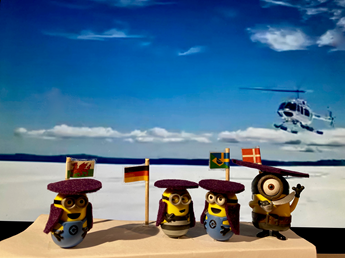
Figure 1 DEEP PURPLE ‘minion’ PIs: (from left to right) our supreme Welsh primo leader Martyn Tranter, the unashamedly European, yet of German descent puzzle master Liane G Benning, the Brazilian/Swedish superstar Alexandre Anesio and our Danish, sword wielding camp master Lasse Twiggs Degn in the appropriate DEEP PURPLE PI attire

Figure 2 The multinational and diverse DEEP PURPLE ESR and PI team are ready to get going for the 2021 field season in Greenland!!

We started with plan A, changed that to plans B, C, D ….. and after ~ 8 months of discussion and changes we are now at plan Q or so. We all know that once on the ice the conditions will force us into plan Z+++++, but we are all prepared for that (well almost all !).

So how did we manage to pull it off? 

Well, we have not yet, but DEEP PURPLE team 1a (of 5 teams) is already in Greenland and team 1b just departed Copenhagen airport. Teams 2, 3, 4 and 5… will follow in 5,10…etc days.  

Part of the DEEP PURPLE team 1 did a reconnaissance flight yesterday to establish base camp location and to test field communications.

Figure 3 (a) Reconnaissance flight was used to establish base camp location for DEEP PURPLE 2021, test drone and communications via Garmin and Satellite phone - all worked and we are ready to go (map sent as text via Garmin by @Rey Mourot)

Figure 3 (b) Selfie of the reconnaissance crew (Joe Cook, Martyn Tranter, Eva Doting, Rey Mourot and Pilu (pilot from https://www.sermeqhelicopters.gl/) at the DEEP PURPLE 2021 field base camp enjoying the sunshine and assessing conditions for deployment. (photo copyright @Rey Mourot)

Figure 3 (c) Drone image of DEEP PURPLE base camp area in S Greenland; note helicopter at bottom left side for scale (photo provided by @Joe Cook)

So what did it take to make this happen? Here some of my thoughts. I am sure Martyn, Alex, Lasse and the whole team have their own stories.

It all started in our weekly DEEP PURPLE PI discussions. We first agreed on the maximum number of people to have in camp at one time; we started with maximum of 10 people, raised it to 12 … and ended up with maximum 16 people in camp, a total duration of the field season from door to door of 50 days and a total of ~ 570 people days in camp. Let the science rule!!. 

With such a big and complex camp, there were many possibilities of how to achieve / manage this, giving everyone enough time to fulfil their science objectives, while remaining within the camp size limits and allowing for changes due to weather etc etc. Planning such a camp needed several puzzles to be solved simultaneously, some of which are briefly shown below. Luckily, having a somewhat anal but organised puzzle-loving German among the PI’s was not a bad thing (the alternative would have been a Welsh or Brazilian ‘organised’ camp!)

So, in early 2021, I started assembling a constantly changing plan and after many, many, many, many, permutations / discussions / changes the current plan foresees 6 consecutive, yet overlapping teams, who will spend a total of ~ 570 people-days in camp.

Figure 4 How to put 27 people in a DEEP PURPLE camp for field work, while not surpassing 16 in camp but giving all the needed on-ice time for the research (Liane G Benning, puzzle no  1 version xx)

To do our work on the ice, we will have 4 lab tents filled with loads of loads of science gear from microscopes to drones and from pumps to pH meters, cryp-shippers etc. etc. (~ 90 boxes and cases worth of it). All this will be powered by a big solar array and two wind turbines. We also thought hard about the fact that our ~570 days on ice also equates to ~ 570 ‘crap’ days on the ice, so our Teams WikiCrapia channel had some – to say the least – interesting suggestions/discussions on this subject.  

Figure 5  To allow all our DEEP PURPLE samples to be preserved well we came up with a rotating cryo-shipper schedule (Liane G Benning, puzzle  no 2 version xx)

Finally, in camp, each team member will sleep in their individual tent, but we will all cook and eat together in a large mess tent in which we will consume ~1000 kg of food. To make the camp run smoothly, besides tent relocations, day-to-day logistics and keeping power going etc., we also have a camp ‘chores’ rota with daily-designated duties for everyone from preparing breakfast or dinner, washing dishes, fetching water and all the way to the dreaded ‘crap’ job!  Ignoring or not doing ones scheduled chores results in automatic assignment of additional ‘toilet-cleaning’ duties! Thus I am sure everyone will do their duties πŸ˜‰.

Figure 6 DEEP PURPLE summer 2021 camp chores schedule (Liane G Benning, puzzle no 3 version xx)

Only fair play and teamwork will make our camp plans possible, but with this excellent team of people we, the PIs, will be able to just sit back, relax and enjoy camp life in the sun with a nice whiskey or gin and tonic while the camp runs itself like a dream and the science happens πŸ˜€ 

Many more details about how we managed to get here and how we pulled it off once on the ice will come via further blog posts on the DEEP PURPLE website (see already the brilliant RISO ECR preparation blog).  Thus, stay tuned and follow us on Twitter.