Showing posts with label Liane G Benning. Show all posts

Tuesday, 6 July 2021

DEEP PURPLE PI musings – how a bunch of cryo-minions study ice darkening (or are we mad to put 27 people in a tent camp on the Greenland Ice Sheet in 2021?)

 by Liane G. Benning

As one of 3 @DeepPurpleERCSy PI’s I can only say that I am extremely glad that the summer 2021 DEEP PURPLE field season has finally started! 

In 2020 we had 7-8 people in camp and did some great science. We knew that in 2021 we would hire a whole slew of new ECR’s, who will shape the science focus for the rest of the DEEP PURPLE grant duration. We also hoped that maybe humanity would behave and COVID would not still be with us in the summer of 2021, but hope is a good thing.

Nevertheless, in October 2020 we decided to have a ‘bigger, stronger and more ambitious’ summer 2021 season. Deluded, I know, but we wanted to let a large team of eager scientists loose to test our hypotheses and fulfil the science dreams for which @Alex, @Martyn and I (@Liane) were awarded the @ERC Synergy grant DEEP PURPLE.  

Below some of my thoughts of how a bunch of DEEP PURPLE ‘minions’ planned and organised a massive summer field season. 

Looking back, I often wondered what made us believe that it would be a good and feasible  idea? The answer is actually rather simple!  We had no choice! 

We hired a fantastic and highly diverse group of ECRs from all over the world and each and every one of them came up with brilliant fieldwork plans to address various aspects of our research questions … so we simply had no choice. We had to do it !!

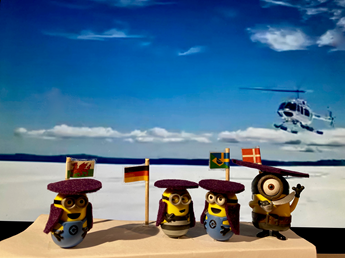
Figure 1 DEEP PURPLE ‘minion’ PIs: (from left to right) our supreme Welsh primo leader Martyn Tranter, the unashamedly European, yet of German descent puzzle master Liane G Benning, the Brazilian/Swedish superstar Alexandre Anesio and our Danish, sword wielding camp master Lasse Twiggs Degn in the appropriate DEEP PURPLE PI attire

Figure 2 The multinational and diverse DEEP PURPLE ESR and PI team are ready to get going for the 2021 field season in Greenland!!

We started with plan A, changed that to plans B, C, D ….. and after ~ 8 months of discussion and changes we are now at plan Q or so. We all know that once on the ice the conditions will force us into plan Z+++++, but we are all prepared for that (well almost all !).

So how did we manage to pull it off? 

Well, we have not yet, but DEEP PURPLE team 1a (of 5 teams) is already in Greenland and team 1b just departed Copenhagen airport. Teams 2, 3, 4 and 5… will follow in 5,10…etc days.  

Part of the DEEP PURPLE team 1 did a reconnaissance flight yesterday to establish base camp location and to test field communications.

Figure 3 (a) Reconnaissance flight was used to establish base camp location for DEEP PURPLE 2021, test drone and communications via Garmin and Satellite phone - all worked and we are ready to go (map sent as text via Garmin by @Rey Mourot)

Figure 3 (b) Selfie of the reconnaissance crew (Joe Cook, Martyn Tranter, Eva Doting, Rey Mourot and Pilu (pilot from https://www.sermeqhelicopters.gl/) at the DEEP PURPLE 2021 field base camp enjoying the sunshine and assessing conditions for deployment. (photo copyright @Rey Mourot)

Figure 3 (c) Drone image of DEEP PURPLE base camp area in S Greenland; note helicopter at bottom left side for scale (photo provided by @Joe Cook)

So what did it take to make this happen? Here some of my thoughts. I am sure Martyn, Alex, Lasse and the whole team have their own stories.

It all started in our weekly DEEP PURPLE PI discussions. We first agreed on the maximum number of people to have in camp at one time; we started with maximum of 10 people, raised it to 12 … and ended up with maximum 16 people in camp, a total duration of the field season from door to door of 50 days and a total of ~ 570 people days in camp. Let the science rule!!. 

With such a big and complex camp, there were many possibilities of how to achieve / manage this, giving everyone enough time to fulfil their science objectives, while remaining within the camp size limits and allowing for changes due to weather etc etc. Planning such a camp needed several puzzles to be solved simultaneously, some of which are briefly shown below. Luckily, having a somewhat anal but organised puzzle-loving German among the PI’s was not a bad thing (the alternative would have been a Welsh or Brazilian ‘organised’ camp!)

So, in early 2021, I started assembling a constantly changing plan and after many, many, many, many, permutations / discussions / changes the current plan foresees 6 consecutive, yet overlapping teams, who will spend a total of ~ 570 people-days in camp.

Figure 4 How to put 27 people in a DEEP PURPLE camp for field work, while not surpassing 16 in camp but giving all the needed on-ice time for the research (Liane G Benning, puzzle no  1 version xx)

To do our work on the ice, we will have 4 lab tents filled with loads of loads of science gear from microscopes to drones and from pumps to pH meters, cryp-shippers etc. etc. (~ 90 boxes and cases worth of it). All this will be powered by a big solar array and two wind turbines. We also thought hard about the fact that our ~570 days on ice also equates to ~ 570 ‘crap’ days on the ice, so our Teams WikiCrapia channel had some – to say the least – interesting suggestions/discussions on this subject.  

Figure 5  To allow all our DEEP PURPLE samples to be preserved well we came up with a rotating cryo-shipper schedule (Liane G Benning, puzzle  no 2 version xx)

Finally, in camp, each team member will sleep in their individual tent, but we will all cook and eat together in a large mess tent in which we will consume ~1000 kg of food. To make the camp run smoothly, besides tent relocations, day-to-day logistics and keeping power going etc., we also have a camp ‘chores’ rota with daily-designated duties for everyone from preparing breakfast or dinner, washing dishes, fetching water and all the way to the dreaded ‘crap’ job!  Ignoring or not doing ones scheduled chores results in automatic assignment of additional ‘toilet-cleaning’ duties! Thus I am sure everyone will do their duties 😉.

Figure 6 DEEP PURPLE summer 2021 camp chores schedule (Liane G Benning, puzzle no 3 version xx)

Only fair play and teamwork will make our camp plans possible, but with this excellent team of people we, the PIs, will be able to just sit back, relax and enjoy camp life in the sun with a nice whiskey or gin and tonic while the camp runs itself like a dream and the science happens 😀 

Many more details about how we managed to get here and how we pulled it off once on the ice will come via further blog posts on the DEEP PURPLE website (see already the brilliant RISO ECR preparation blog).  Thus, stay tuned and follow us on Twitter.

Wednesday, 29 July 2020

Snow to ice transitions

By Liane G. Benning
 
Despite a few days of sleep and lying low, I don’t know how to properly recover from this marvellous and, compared to many international colleagues, unique opportunity that we were awarded. Against all odds and with preparations and shipments that could have been for nothing, in the end the team made it onto the ice and we managed to carry out a glorious (and at times harder than expected) 3-week field season in the summer of 2020 in Greenland. 
 
This success was an enormous team effort and as Martyn and Alex already mentioned it is all down to the 3 young ESR’s (Eva, Laura and Rey) and to Lasse (our camp manager and all round fixer par excellence) as well as the help of the local pilot crew around Pilu from www.sermeqhelicopters.gl that it all worked out in the end.
 
We are all safely back now. Our travel to Greenland was preceded by an individual pre-departure Covid1 SARS CoV-2 test, if required the 5-day Greenland quarantine and an antibody test on the ice (thanks Alex). While on ice and away from ‘the world’, we felt safe and that the ‘real’ world was far away and COVID19 became almost irrelevant; viruses were only a part of the microbiome that we studied and only an issue in our snow and ice samples and not in/on us. 
 
We had a fabulous – yet at times tough time - strong winds and way, way more rain than we wanted is just one part of the story. We managed to do fabulous science, perform complex experiments, do in situ measurements and collect snow-ice core transitions – all stories that the ERS’s will tell in their own time. We had a well working camp with great food and high spirits even in the most dismal times and a team that I would not exchange for anything. Thanks all !
 
For me scientifically it was also a perfect start and snow-ice darkening transition season. Based on our work at S6 during Black and Bloom, I was almost ready to maybe accept that snow algae are less of a player in the Greenland darkening game. Alas, this season restored my faith in snow algae and their crucial role in the melt enhancing and albedo lowering processed on Greenland. We caught an ideal snowy start (crevasses notwithstanding), with plenty of red snow algae patches all over our camp and work area; with time, melt proceeded as expected and with the rain and strong winds some of these red snow algae patches melted away and transitioned, over the 3 weeks, into dark, ice-algae dominated surfaces; yet some red snow algae fields still persisting until the end. We also saw during our dash to QAS-U that red snow fields were everywhere; even Pilu, our helicopter pilot said he sees them all the time when he flies over the ice sheet. We even saw them at depth (but that is another story); thus, my beloved snow algae are still in the game; phew….

Flying over the dark ice of South Greenland reveals how albedo changes fast during melting

These snow-ice transition processes that we closely observed and lived through this summer were part of our Deep Purple hypothesis, yet they turned out to be way more fascinating than we all assumed. Melting, enhanced and highly affected by rain and wind, gave us even more insights into what we don’t know and how we need to proceed if we want to disentangle the mechanisms and roles of the individual components in this complex, ever changing system; this field season also showed us a likely scenario of ‘what is to come’ in many other areas in Greenland and the Arctic. It showed us how little we understand these fast changing supraglacial systems, where darkening is not just unavoidable but governed by a very complex, highly logical and tight interplay between physics (hydrology) biology (microbes) and chemistry (minerals and soot) that we still have to decipher.  
 
Living on ice and doing science on ice has led to many funny stories and the videos and photos are plentiful and these will emerge slowly in subsequent blogs. Below just a smidgen of those I took.

The top of the ice core is full of dark material that consists of minerals and many many ice algae that change the watering crust

Blue ice coring with a blue ice corer ;-)

A happy filtration tent (note expert tables made by Lasse Deng) and with Laura Hallbach, Alex Anesio, Eva Doting and Rey Mourot all stressing our solar array with many pumps running simultaneously 

Wednesday, 24 June 2020

Preparing for Greenland field work in times of COVID

By Liane G. Benning

Being allowed to do field work this summer is a huge privilege and we are not taking it lightly – the inherent dangers of the virus we all live with are very real.  We had in a frenzy packed and shipped all our gear (and some) in early June although we did not yet know then if we would get a permit, find flights, be allowed into Greenland, or arrange a field camp etc etc. The moral issue about going at all to a virus-free country weighed heavily on our minds. At least for myself I almost became a hermit and distanced myself from all humans for the last 3 weeks so as not to jeopardise our chances and possibly get infected. I did eat loads of salad to prepare for the lack of it on the ice, and once @Rey_Mourot arrived back from the ‘exile’ in France, we did final lab preparations… 

Stocking up on salad in preparation for the lack of it on the ice

@Rey_Mourot doing the sterilisation of the mineral mix for the in situ and fertilisation experiments… to be done soon on the Greenland Ice Sheet


All planning and care is however useless in the light of the possibility that at the last moment a test comes back positive for any of us. 

Alas, the advance @DeepPurpleERCSy team consisting of our fearless leader @MartynTranter1 and, as far as I know, our youngest team members @Rey_Mourot and myself @LianeGBenning have all tested negative and can thus tomorrow embark on the 1st leg in our 6-stop journey to our field site in south Greenland. Tomorrow evening we transit through CPH airport and meet the DK part of the DeepPurple team. On Friday morning (crossing all digits that we have all paperwork we need – I counted 20 pieces) we will hopefully be allowed to board the AirGreenland plane to Kangerlussuaq/Nuuk/Narsarsuaq. That will be followed by 5 days quarantine in the airport hotel combined with lots of hope for all to go well. There are many possible plans B, C, D, …X, yet ultimately keeping everyone safe at our end but also in the Greenlandic community is the only thing that matters. The next step is to be united with the 2nd part of the team and getting onto the ice.

Only once we are left behind by the helicopter on the ice sheet will we be convinced that field work this summer will indeed happen. 

But I am after all the eternal optimist so it will work out somehow. 

We are a GO! (for now)

Saturday, 6 June 2020

Did I send everything we need for our summer field work..?

by Liane G. Benning

Hope is the last thing to die, and for me as an eternal optimist, hope and its best 2nd cousin - preparation - partly saved our summer field trip; despite lockdown since middle March, and the cancellation of our spring trip, the ever growing @DeepPurpleERCSy team discussed and planned for every eventuality despite not knowing if we will be able to go at all, or for how long. Thus, unsurprisingly we made plan A, B, C, D ….X … Should one plan and pack for sampling and in-field experiments for 1 week or > 1 month? Invariably we took the approach - plan for everything and react to the situation.

The @GFZ_Potsdam @DeepPurpleERCSy team could not have done this without the tireless help of Marc Paje – our lab technician; he and I had many discussions and exchanges through endless Skype, Zoom, WhatsApp, Slack and you name it e-platforms; together with @Chris_Trivedi and @knutkonopke and our team's PA Sandy Herrmann all in lockdown in Potsdam and with @Rey_Mourot stranded in France, we slowly managed to not just plan for every possibility and order the needed consumables and field gear (including having to purchase new Zarges boxes …grrrr – that is another story) but do this while fine-tuning our field sampling, sample handling and sample processing procedures to be as flexible as possible. Not to forget the help from all members of with @AlexAnesio's team in Denmark.  

Naturally plans are good but … nothing prepared me for the storm of activity once we decided to pack and ship even if in the end we could not go. To do this at the best of times in 3-4 days is a tall order – to do this in 3-4 days while under “only essential presence at work return rules” and while wearing masks and following all social distancing rules was even harder but ultimately the glorious sight of our 9 boxes all packed, inventoried and labelled was a good reward;


To get our gear/consumables to Greenland we needed to first ship it to Denmark where it was combined with @AlexAnesio team’s consumables and the very important camping and safety gear for all of us; they will tell that story next …
 
I don’t know if we have managed to pack all we need but ultimately that is irrelevant – if we will manage to go we will do great science together. I could not have done this without the fabulous team effort and inputs from all our early carer scientists and project managers who despite these weird times have all done a fabulous job. Thank you all, and chapeau