Showing posts with label 2020 fieldwork. Show all posts

Wednesday, 7 October 2020

The post-fieldwork blues

by Eva Doting  


While we were enjoying our best meal in weeks served by NiNu's in Qaqortoq, Greenland, on our last evening with the complete fieldwork team, the wise Martyn Tranter warned us about the post-fieldwork blues. We had just come back from almost three weeks on the ice and were feeling all kinds of exhausted and grateful as well as a little confused about returning to a world where COVID-19 was still very much a reality. Somehow, I had been expecting that the world would have returned to normal and sensible while we'd been off the grid, and it was a bit of a disappointment to find out the opposite was true..


Beers and big smiles after a successful expedition, several showers and amazing food at NiNu's. 


Now, almost 2.5 months after returning home from the first DEEP PURPLE expedition, I can safely say that, at least in my case, Martyn's warning was definitely warranted. As per his advice, I scheduled in some rest; five days to visit my parents in the Netherlands. Lesson learned: I need more than five days to rest, get rid of all the tight knots in my body from changing-clothes-in-a-tent-manoeuvres and carrying odd-sized items across an ice sheet or heli-pad and to come up with a post-fieldwork game plan. Once back in the lab, I got back to work on a whole bunch of samples that needed my attention, both from 2020 fieldwork but also things that I had abandoned when we rushed into the first COVID-19 lockdown back in March. While I really love my PhD research and my colleagues, my head was still somewhere between Greenland and the lab. I feel a little bad about the number of times I told my supervisor Alex: "I really want to do this, but I just DON'T want to do it right now...!!!" After spending crazy hours preparing for fieldwork during a pandemic, not knowing if we'd be able to go, COVID tests, traveling with masks on, an incredible sense of relief once we landed and days on the ice filled with science, fresh air and focussing on staying warm and fed, it was overwhelming to have a constant stream of news and indoor work again. 


It took a while, but I am finally back in the swing of things: I have exciting samples to analyse, intimidating data to process, planning of new lab work to look forward to and amazing colleagues to discuss data and science with. Lots more fun to come!

Friday, 31 July 2020

Some insights into the struggles and joy of fieldwork in a camp on the ice

By Laura Halbach

Being back in Copenhagen, I feel happy about the regained comfort of modern civilisation: having a comfy mattress to sleep on, no distractions of a flapping tent wall mimicking the noise of bear paws scratching over the tent during the night and a warm and proper shower. While trying to get back into my normal work routine, I am using the opportunity to recap some of the exciting moments on the ice while the memories are still fresh and adding my perspective to the stories below.

The last weeks before Greenland: What a marathon!!

Sitting in the plane to Greenland gave me mixed feelings of excitement, exhaustion and relief. The last weeks before our departure was a marathon and my mind could barely relax, being constantly worried about weather I am forgetting anything. What about all the last minute orders I placed, will everything arrive? Did I mix up anything? Was 0.2 µm really the right pore size for analysis x? In the end, you have what you have on the ice. Knowing that the GFZ team brings their own science kit made me feel a bit more relaxed, since this will allow for some improvisation if something has been forgotten.

First week on the ice: Getting the science started

Arriving at the camp location makes me feel excited: I participated in a range of field work before, but often I could enjoy the comfort of a ship or at least a hut, but now we all would have to deal with living and working in tents. This means limited power supply and exposure to the weather (which turned out to be actually not as bad as I expected after Jason’s warnings about the heavy rainfall that is typical for this region). But that also means, having the possibility to observe the ice crust, the microbes and meltwater dynamics RIGHT OUTSIDE your tent. How cool is that?! Our first week was all about setting up the camp, the lab, our science gear and already spotting some good locations for potential sampling and experimental sites.

Observing cryoconites developing right outside my tent (top-left) and my beautiful bottle incubations (top-right) and me being happy that they worked out (bottom). Photos Laura Halbach

Second week: Science is running and daily routines are established

During the following days, the science took off (as did the algae bloom) and I started to take care of my first experiment: an in situ fertilisation of the glacial microbial community with different nutrients and minerals. I decided that fertilising two times a day would be best, as the nutrients may be quickly washed off. The gardening-like activity (it looked like I am watering imaginary plants) turned out to be a great and relaxing start of the day for me, being a non-morning person. The morning routine was complemented with some nice and creamy porridge and a big smile from Alex, who is always in a good mood and doesn’t mind spreading it. Thanks to Lasse, we ended up with two nice lab tents, each of them fitted with designated lab tables, which were sawed nicely matching the tent shapes.

Our ice camp at the beginning (left) with lots of snow cover and towards the end (right) with melted snow and some melt ponds and streams developing on the ice surface. Photos Laura Halbach

Third week: Science, science, science and wait… is this our last week ?!

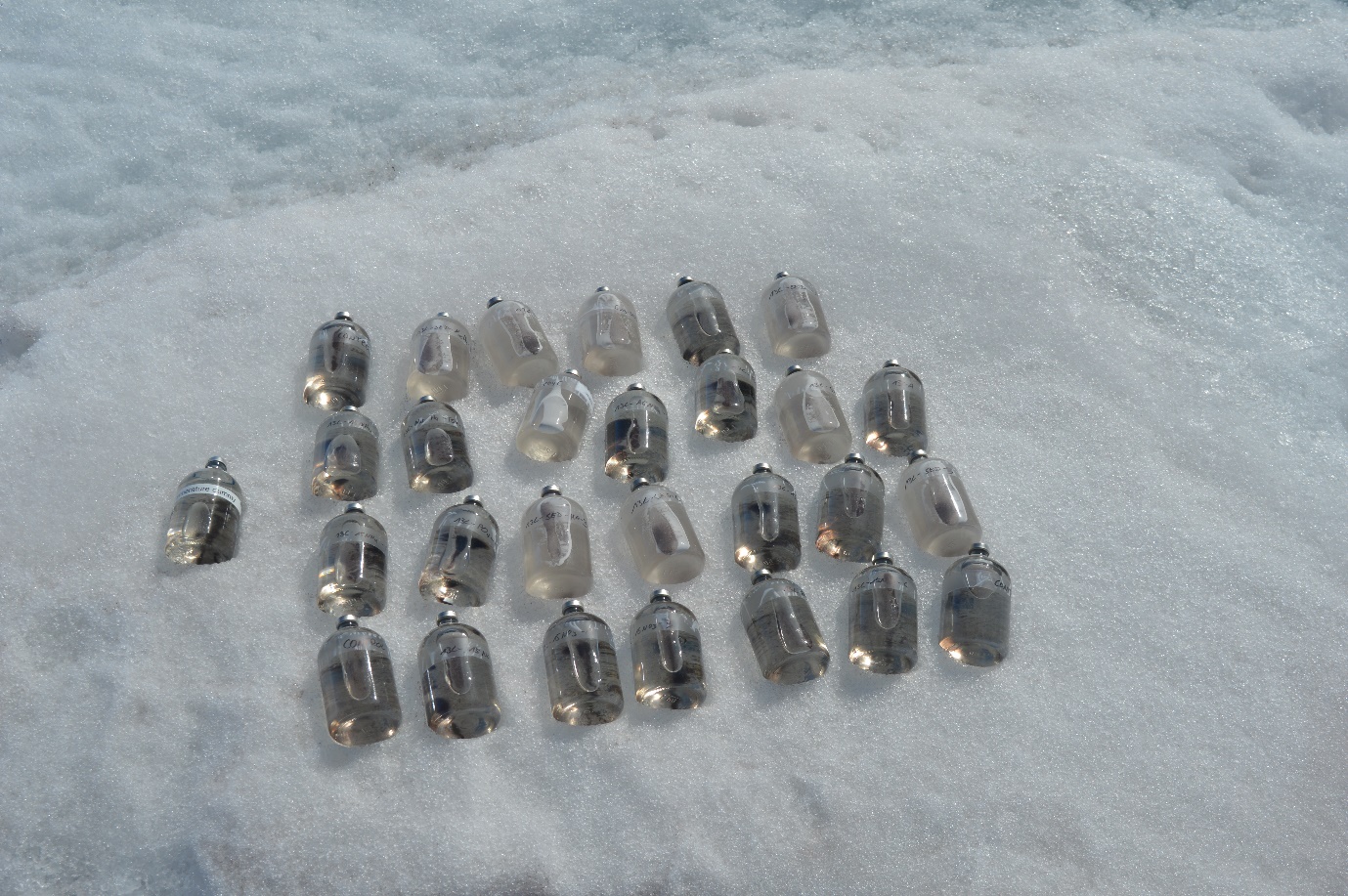
During some days of A LOT of rain, I got reminded of how little fun camping in rain is. I try to see the positive side of it and remind myself that we might be lucky to the rain signal in our data sets. The slightly lowered mood in the camp during the days of rain, was contrasted by delicious food cooked in the kitchen tent during all evenings. I still remember that smell of the rich potato, cheese combination a la cuisine francaise by our young star chef Rey, that was just the perfect meal for that weather… So delicious! Somewhere in the middle of our expedition, I started to count our remaining days on the ice and realised that there was not thaaat much time left. The strong rain event showed me how easily all our science activities could be interrupted. Therefore, the next days with better weather would be the time to start the second experiment: again a fertilisation approach but this time under “ex situ” conditions in small glass bottles, which were left on the ice for 24 hours. The bottles were spiked with stable isotopes (C13 and N15) and additionally amended with a phosphorous solution and mineral mixes, the latter kindly provided and prepared by Liane and Rey. Thanks to the big support by Katharina Kitzinger from the Max-Planck-Institute in Germany, the experiment will give new insights into the productivity and nutrient uptake by the whole community, as well as on a single cell level. But since the Greenlandic weather gods don’t seem to like me ending experiments, just as last year, the final sample analysis and filtration work got interrupted by a storm approaching the camp site. Securing the camp site had first priority and we had to take down one of our lab tents, move the other lab tent and secure the whole camp site. Me, trying to be happy that we are not leaving the camp site already on that day (-> = processing ALL samples in the hotel), then rushed through a series of last sample processing and filtration work, trying to use every last hour that was left during our last two days for science. This involved long nights (not too long, since I get far too easily scared by sitting alone in the dark in a tent and again, hearing the noise of potential bear paws outside), early mornings and the support by the whole team, and particularly the big help by Alex and Rey.


Video of the beginning of the storm.


This could have been one of the last pictures taken of Alex: it was the night of the big storm and the night when Alex was almost blown off the ice sheet in his tent (see his video further down), luckily Lasse our hero could save him during the night. Photo Laura Halbach

One of my favourite pictures: showing Alex, in the back, Eva and Rey filtering and sitting at the table and Liane microscoping on the floor, since this was the very last spot available in the tent. The night before, we had to take down the other lab tent, so all lab activities had to be merged together on very little space. Luckily, everyone is easy-going and Liane and Alex, don’t mind improvising. Photo Laura Halbach

Great lab processing team :) Photo Laura Halbach

It took us until the very last day, until all science gear was stored away safely into boxes, locked by several layers of duct tape, that we, finally, took the time to go out for a walk and explore our glacier more. This last evening on the ice was rewarded with an exceptionally beautiful sunset.

I am very proud on what we have achieved, the great team effort that made all of this possible and I can’t wait to see what will come out of the experiments!

Liane and Rey happy (left), ESR's Team (right). Photo Laura Halbach

Last evening on the ice. Photo Laura Halbach

Great team! Photo Laura Halbach

Wednesday, 29 July 2020

Snow to ice transitions

By Liane G. Benning
 
Despite a few days of sleep and lying low, I don’t know how to properly recover from this marvellous and, compared to many international colleagues, unique opportunity that we were awarded. Against all odds and with preparations and shipments that could have been for nothing, in the end the team made it onto the ice and we managed to carry out a glorious (and at times harder than expected) 3-week field season in the summer of 2020 in Greenland. 
 
This success was an enormous team effort and as Martyn and Alex already mentioned it is all down to the 3 young ESR’s (Eva, Laura and Rey) and to Lasse (our camp manager and all round fixer par excellence) as well as the help of the local pilot crew around Pilu from www.sermeqhelicopters.gl that it all worked out in the end.
 
We are all safely back now. Our travel to Greenland was preceded by an individual pre-departure Covid1 SARS CoV-2 test, if required the 5-day Greenland quarantine and an antibody test on the ice (thanks Alex). While on ice and away from ‘the world’, we felt safe and that the ‘real’ world was far away and COVID19 became almost irrelevant; viruses were only a part of the microbiome that we studied and only an issue in our snow and ice samples and not in/on us. 
 
We had a fabulous – yet at times tough time - strong winds and way, way more rain than we wanted is just one part of the story. We managed to do fabulous science, perform complex experiments, do in situ measurements and collect snow-ice core transitions – all stories that the ERS’s will tell in their own time. We had a well working camp with great food and high spirits even in the most dismal times and a team that I would not exchange for anything. Thanks all !
 
For me scientifically it was also a perfect start and snow-ice darkening transition season. Based on our work at S6 during Black and Bloom, I was almost ready to maybe accept that snow algae are less of a player in the Greenland darkening game. Alas, this season restored my faith in snow algae and their crucial role in the melt enhancing and albedo lowering processed on Greenland. We caught an ideal snowy start (crevasses notwithstanding), with plenty of red snow algae patches all over our camp and work area; with time, melt proceeded as expected and with the rain and strong winds some of these red snow algae patches melted away and transitioned, over the 3 weeks, into dark, ice-algae dominated surfaces; yet some red snow algae fields still persisting until the end. We also saw during our dash to QAS-U that red snow fields were everywhere; even Pilu, our helicopter pilot said he sees them all the time when he flies over the ice sheet. We even saw them at depth (but that is another story); thus, my beloved snow algae are still in the game; phew….

Flying over the dark ice of South Greenland reveals how albedo changes fast during melting

These snow-ice transition processes that we closely observed and lived through this summer were part of our Deep Purple hypothesis, yet they turned out to be way more fascinating than we all assumed. Melting, enhanced and highly affected by rain and wind, gave us even more insights into what we don’t know and how we need to proceed if we want to disentangle the mechanisms and roles of the individual components in this complex, ever changing system; this field season also showed us a likely scenario of ‘what is to come’ in many other areas in Greenland and the Arctic. It showed us how little we understand these fast changing supraglacial systems, where darkening is not just unavoidable but governed by a very complex, highly logical and tight interplay between physics (hydrology) biology (microbes) and chemistry (minerals and soot) that we still have to decipher.  
 
Living on ice and doing science on ice has led to many funny stories and the videos and photos are plentiful and these will emerge slowly in subsequent blogs. Below just a smidgen of those I took.

The top of the ice core is full of dark material that consists of minerals and many many ice algae that change the watering crust

Blue ice coring with a blue ice corer ;-)

A happy filtration tent (note expert tables made by Lasse Deng) and with Laura Hallbach, Alex Anesio, Eva Doting and Rey Mourot all stressing our solar array with many pumps running simultaneously 

Monday, 27 July 2020

Back and Happy

By Alexandre Anesio

After almost three weeks camped on the ice without any internet and completely detached of the world, we are now all back home to Denmark, Germany and the UK. Samples are safe in our laboratories at a variety of temperatures from -80 to +4 degrees C for a range of chemical and microbiological analyses. I still can hardly believe that we could mobilize such paraphernalia for fieldwork on the Greenland ice sheet in times of COVID-19. An extremely efficient logistics manager (thank you so much Lasse Twiggs Degn), flexible and welcoming local community and very strong minded and willing PhD students, postdocs and PIs made this possible. No regrets. I have learned a lot of new things about the life cycle of glacial algae, compared to previous years. A combination of good timing and weather conditions allowed us to have arrived just at the snow transition to bare ice. This provided the opportunity to collect a bunch of ice cores that shows where glacier algae lie during the winter, the impact of hydrological processes, such as snowmelt and rain on the distribution of glacier algae and how glacier algae colonize white surfaces to darken the ice during the summer season.


The dark spots in this ice surface are almost entirely composed by ice algae and translucent minerals. By scrapping the surface into a small pile of ice, one can clearly see the pink-purple coloration of the ice that contributes to the melt of the Greenland ice sheet. Photo Alex Anesio

The PhD students (Eva Doting, Laura Halbach, Rey Mourot) and logistics manager (Lasse Twiggs Degn) did such a brilliant job through the fieldwork and got everything they came for. Photo Eva Doting

PI Martyn Tranter was “wood for every construction” (to use a Brazilian expression, meaning that he was in high demand). His albedo and ablation pole measurements were in high demand by all the PhD students. Photo Eva Doting

PI Liane Benning under high wind conditions, preparing to collect a box of surface ice. Photo Eva Doting

Crevasses and polar bears are overrated. Wind turned out to be, at least for me, a much bigger nuisance. This is a video from inside Alex’s tent…

I have learned a lot scientifically, but I am also delighted that I have learned so much from my colleagues during long conversations in the field. Here is what I learned:

  • The film Titanic is classified as a romantic comedy by one of the PhD students.
  • The sound description of drinking a pint of beer is “puff, puff, puff”, which is quite impressive since I would need at least 20 puffs to get through a pint.
  • I have learned new expressions in Danish. Der er ingen ko på isen (no cow on the ice) means ”no problems” and I thought it was pretty appropriate considering where we were. However, my wife, who is Swedish, claims that the Danes copied the expression from the Swedes….
  • I could not have guessed this, but some people think football is boring.
  • If you are hungry in an ice camp, even super overcooked macaroni with a half-heated tuna in water can actually be tasty.
  • Cucumbers are the fourth state of water. Ok, this is my own….

Beyond the great companionship and exciting science during these 3 weeks, I have also been constantly reminded how beautiful the Greenland ice sheet is and the feeling to be surrounded by ice and amazing skies.

Photo Alex Anesio

Wednesday, 22 July 2020

First field season completed – blooming algae everywhere

by Martyn Tranter

We left the field on Sunday (19th July), began preparing our equipment and samples for return immediately, and Alex, Laura and I returned to Denmark with samples in cryo-shippers and ice boxes yesterday (Tuesday, 21st). I am writing this short piece in the comfort of a hotel room at Copenhagen Airport. Eva, Lasse, Liane and Rey are finishing the packing in Qaqortoq today, and will return tomorrow. We’ve had a pretty intense four weeks, and we all need some time to recharge, but it was well worth the hardships, as I hope the following sample shows.

Alex, Eva, Laura, Lasse and Jason Box (from GEUS) literally got off the plane in Narsarsuaq on June 30th, walked into the Sermeq helicopter and were at our field site within an hour of landing. They effectively quarantined for COVID on the ice. Liane, Rey and I tested negative again before we left. We set up camp near the PROMICE (https://www.promice.dk/home.html) KAS M site.

Our camp site, near to the PROMICE QAS M weather station (which is ~200 m to the right out of sight). 

I honestly thought that the southern tip of Greenland would be as warm as it could get for summer fieldwork on the ice sheet, but Jason had warned that you get a full house of variable weather most weeks. We experienced the “balmy south” for a couple of days only – beautiful weather, bright blue skies and no need for an outer jacket.

Eva and Liane dining al fresco in the (rare) warm evening sun.

Otherwise, we had camped in a cold summer with plenty of rain and lots of wind. Fortunately for Jason, he left after a few days, having installed a rain gauge on a nunataq near by. This seemed to provoke the glacier gods into an attempt to wash it away with a downpour or too. We’ll certainly know if the automatic rain recording works, and the data will be invaluable in our understanding of how the darkening ice surface evolved. The practical consequences of being wet while camping on ice are a pain. You’re cold, in takes a long time to warm up, and drying your wet things inside cold tents takes a long time. The dank smell lingers on your clothing too.

It’s hard to capture cold, wind and rain in a photo, but you get a good impression of us being cold and tired from this photo. Liane, Alex, Laura and Lasse are, what Aussies call, pooped.

Did the glacier algae care about the cold, wet and windy weather? Not a bit. They were everywhere, happily multiplying and colonising new surfaces.

A shot from a helicopter ride out of camp mid-season towards the snowline. The ice surface is black almost as the snow melts.

The black circle is a 52mm lens cap, but the clumps of black and black covering to the ice crystals are largely glacier algae. They thrived everywhere there was melt.

One of my favourite microbiologists, Alex, always happy when he’s looking at glacier algae through his microscope. 

Our three Ph.D. students, Eva, Laura and Rey worked flat out and around the clock to compensate for time lost due to rain and high winds, Alex and Liane ensured that the lab tents were functioning as best they could, and did great jobs sampling and filtering, and Lasse became our key man in building and maintaining a functional camp, keeping our personal tents safe, and patrolling all hours of the night to ensure that we didn’t blow away in the storms. We all were well down on good quality sleep, but Lasse was more machine than human during the worse of the winds. We would have pulled off the ice early had it not been for his skill and calm in keeping us safe. 

Rey about to retrieve his first ice core from under a 1.5m deep snowpack. We are going to learn how glacier algae “hibernate” over the winter. Microbiologists will hate this turn of phrase for sure.

Laura’s incubations basking in the sunlight.

Laura looking a lot happier in the warm of the science tent.

Liane ensuring that the science tent was productive. Rey demonstrating that gloves need to be worn at all times when processing microbial samples. 

The last week on fieldwork was something of a frenzy, with lost time being made up at the expense of sleep and breaks. Lasse did a sterling job working around us to ensure that all was packed up as early as possible, ready for the helicopter decamp.

A sample of packed up camp and trash, ready for return to Qaqortoq by helicopter. 

Eva watching Lasse deal with the first sling load out of camp.

Lasse, more machine than man, after a great three weeks of keeping our bodies, souls and the camp together.

My final thanks go to Pilu Nielsen of Sermeq Helicopters (https://www.sermeqhelicopters.gl/). He could not have been more helpful, flexible and professional, and is ultra-knowledgeable about local conditions, ad who to get hold of to do what. Expeditions and holiday makers, he is top drawer and gets my unreserved recommendation. 

There will be other field and science blogs to follow. The bottom line is that we learnt tons, and that we have a load of exciting samples to process. We’ll keep you posted on our progress.

Tuesday, 30 June 2020

Picking a camping site and a first helicopter trip

By Rey Mourot 

Hi all! Rey here. I'm the youngest member of the Greenland 2020 team - as my supervisor would say, I'm "the team baby". As a short introduction, I am a future PhD student in Liane's team at the GFZ, and I am the "ice corer" of the Deep Purple team. I will study the organization and composition of microbial communities minerals in the columns of ice, with a special focus on the snow - ice transition - that's where everything happens! I already had (and will have) many "first times" during this expedition! First time in Greenland, first time seeing all kinds of new species of plants and birds, trying new food... But on Friday, June 27 was my first time flying in an helicopter. You should certainly read Martyn's post about our arrival in Narsarsuaq. On our first day here Liane, Martyn and myself had a first look IRL at the ice sheet section we were interested in for setting up our camp. Following many discussion with Jason Box, who will accompany the Deep Purple team for the first part of our Summer 2020 field season, we explored and selected a good camp site. We left the first part of our cargo on the ice, so that we can set the camp fast once our real adventure begins, when the Aarhus team - Eva, Laura, Alex, Lasse, and Jason will join us tomorrow. 

Before flying, in the morning, after hesitation and delays due to low clouds covering the mountains, we received the OK call from Pilu, our helicopter pilot and fixer, that he will come to pick us up in Narsarsuaq airport, direction: the ice sheet! The helicopter was already packed full with Zarges boxes and bags for our field camp.


Fig 1. My 1st helicopter experience

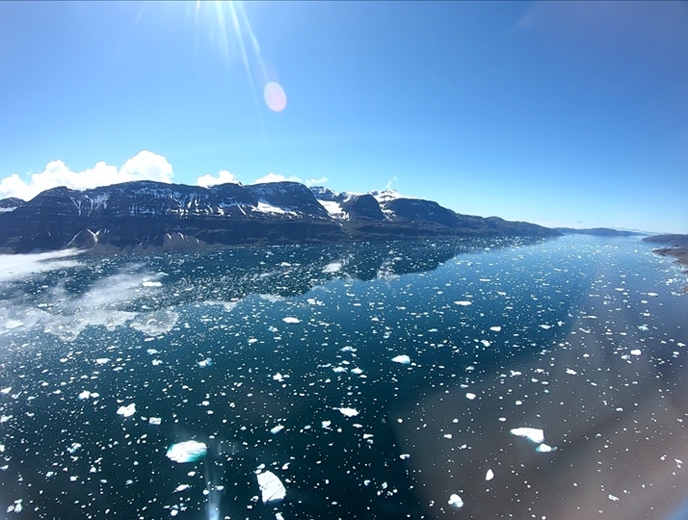
As the clouds disappeared, this first flight in the helicopter was crazily beautiful. The surroundings of Narsarsuaq is full of mountains of all sizes, some covered by green mosses and some species of flowers I still need to investigate. The melted snow forms diverse ponds of translucent water reflecting the sun.


Fig 2. My 1st iceberg landscapes

As we flew by I saw my first real icebergs (another first time!, my previous icebergs sightings were on a glacial river in Iceland), small farms, sheep... and finally, the massive ice sheet. Even if it appears bright white on the distance, as we got closer it became clear that the surface was actually pretty dark due to a ton of dark particles (minerals and algae) that we can see from the helicopter. 

 
Fig 3. Dark ice surface next to Nunatak

We asked Pilu about how the ice sheet melted during the past years, and he estimated a retreat of more than 15 meters a year in some places. Even on a marvellous trip like this one, climate change is frightening...

As we finally approached our intended camp site area, Pilu had to try to land at different places. 

There was still plenty of snow (and visible red snow algae) on the ground and we had to land a bit lower to find a perfect spot, but here it is.

For a small insight on how we're choosing it, see below!

Smart criteria for a good camping site:
- on the bare ice: even if we chose a broad area with no big crevasses to set our camp, the snow is covering potential dangerous patches. So, safety first!
- not too far away from a small river, which we will use as drinking water source, water for doing the dishes... and all human functions that we still do, even during a science mission on an ice sheet.
- slightly elevated, so our tents can be kept safe from melted snow / slush avalanches

Science criteria for a good camping site:
- not too far from a promice.dk met station 
- not too far from a Nunatak (rock promontory in the middle of the ice field) where Jason will install a rain gauge to monitor precipitations. 
- not too far from the snow line so we can follow the melt and algal bloom progression and development but still be able to collect good transitional snow to ice samples 

Over the 3 weeks of camping we will have to move our tents regularly anyway, to follow the snow line and find a new, safer, and less wet spot as the landscape is changing. We found the perfect spot, and even saw a beautiful patch of bright red snow algae on the way! Our camp will be at ~710m above sea level. 

Once we arrived, we disembarked and remained on the ice in the brilliant sun and Pilu flaw back to Qakortoq to pick up the remaining boxes that were waiting for us since the spring - sent there for an April mission which I was supposed to be part of and that was supposed to be with Alex, Jason, and Masashi; alas Covid19 happened! 

We were more than happy to stay for one hour and a half on the ice sheet under a bright sun and beautiful blue sky. Let me tell you, time goes fast when you can listen to Martyn and Liane talking about polar bear and research stories in such a cool landscape. As I'm in charge of the GoPro, I was glad to record some of the weird things the PIs could do to celebrate the finding of the-perfect-site!
 

Fig 4. PI’s being silly

We left our boxes on the ice, and they are waiting to be united with the remaining cargo tomorrow when we come back, this time with the full team... 

After a final return flight …. over marvellous landscapes … my 1st ‘helo’ flight was over and we had a well-deserved beer after this successful day! 


Sunday, 28 June 2020

Unmasking en route to Narasarsuaq

by Martyn Tranter

Elderly masked person in helicopter, Narsarsuuaq, 27th June 2020

I have been locked down at home in Monkton Combe, just outside Bath, for three months. I have been no further than 10 miles from home about three times, and mostly within a mile of home, and this to fish in a very quiet stream at the bottom of the valley, where I barely see a soul. My wife drags me out of the house for a few miles walk on a Sunday morning. We have socialised not more than 10 times, and with both our adult children at home we barely had time to keep in touch with friends as much as we would have liked. Most interactions were via the internet, and those flat 2D interactions are not as subtle as 4D meetings with folk in person.

I booked a COVID test at Bristol Airport on Monday morning (22nd June) and assumed that I would test positive, a false positive of course, and be unable to go into the field. The 17 mile drive to the airport seemed a bit like this man’s first trip to the moon and a little surreal. I didn’t really like being taken out of my routine of loading up the computer and doing e-stuff, remembering to stand up every hour, and trying to finish around 5 with my daily Danish lesson, else you can always find something to work on. Now, it was interacting with real people outside my close family, friends and neighbours again. I didn’t get tested for COVID, I did a self test, which I thought was bonkers, since I could easily bias the result, but I did my best to pierce my tonsils and one of my sinuses with the lethal plastic cotton bud with a long stem, messed up breaking the stem at the wrong place, but still did sufficiently well to be deemed a success at self testing. I drove home slowly, enough to hiss off most cars behind me most of the time, and then felt in limbo. I was convinced I’d test false positive.

The text came at about 05.30 I think, not being great in the mornings, and I was a negative. It was game on for Greenland, and shit……. I had to get ready for the journey. My son drove me to Heathrow, allowing two hours to my doddery three or four. It all seemed a bit fast on the motorway to me. Then, we put on the dreaded face facemasks about five miles from the airport, looking like we were going to draw our guns and rob the place – we’d have been shot for sure with all the security around by the way. The mask gives you a good idea of how stale your breath is and mist up your glasses. It was a pain in the front side to wear, and I kept lifting it when I talked to folk, who were very patient with me to be fair. Ieuan drove off and I was by myself with a rucksack, a large bag of clothes, field equipment and magazines I hadn’t read over the past three months, and my laptop bag containing instructions on where to be and when. Ieuan had loaded them onto a trolley, and I pushed out into Terminal 2. All those people in masks, everyone looking at each other in case of a cough or an unprotected nose or mouth.

If there is a silver lining to COVID, then airport check in and security hassle being minimised just has to be it. I was apprehensive about being around a multitude of equally nervous masked folk, but folk were very friendly, matter of fact and there was so little queuing I didn’t know what to do with the extra two hours I had in the departure lounge. There was plenty of room, folk positioned themselves the maximum distance possible from each other, I was away from my computer screen, and so I made a few phone calls to my family, and spoke/txt’s/e-mailed/What’sApp’d friends that I’d neglected this last three months.

Another silver lining was getting onto the plane. We boarded strictly from the back to the front. Bugger the elite card holders and first class passengers. Elderly folk and folk with young kids get preference of course, but COVID has made the rest of us more equal in place queues. SAS ran the flight with Nordic precision and treated us like adults in terms of telling us what they could and couldn’t provide on the flight anymore. Most of us sat with the gap of a seat between each other. I had to fly to Stockholm first, and change within 40 mins to board the Copenhagen flight. SAS managed that very well too, because despite being 10 mins late departing, they held the Copenhagen flight 10 mins to let 37 folk make the connection. All the luggage made it too. My thought at the time was that I’d make it to Greenland but without any clothes or equipment……

Copenhagen was busy – there were people without masks outside the airport, and they seemed to be relaxed around each other, albeit at a distance of 1m. Liane Benning and Rey Mourot had already arrived from Potsdam, via Frankfurt, and we had to stay in the Clarion Hotel at the airport. The receptionist and staff were relaxed about having a masked old git turn up, looking anxiously around, with too many bags and too little control over his trolly. I could even take the mask off, which by that time was driving me nuts. Then I saw Alex Anesio and  Rey at the bar, and it was like old times, except we didn’t know whether to shake hands, so elbow bumped. He rest of the team turned up over the next hour, and slowly I got used to talking to 4D people again. We ate together – my first meal with folk outside my family in three months – had a few beers in public, and life didn’t seem to be that inward looking, bounded by a mile radius and quite so bad anymore.

Liane, Rey and I had breakfast unmasked with a bunch of other travellers, all 1m removed as a minimum, at about 06.30, and then wandered over to the airport with a bunch of additional equipment that Lasse Degn had left us the previous night, and which Eva Doting kindly brought to the hotel just after breakfast. Masks on again, and the silver lining of fewer people flying made the 09.00 queue for the Air Greenland Flight slightly less chaotic than it usually is. It was going so well – Liane and Rey showed their German negative COVID test results, then I got my UK negative result out. A print out of the e-mail I received. The negative test result did not show the date I had been tested. I showed the text message of the negative result – no test date. I showed the receipt I had been given for my self-tested sample at the airport. Yes, it wasn’t dated. The senior Air Greenland customer services representative who had come across to look after an elderly guy in despair was very patient with me. She said “take a few deep breathes, we can sort this out”, and as I did, it came to me to search my deleted e-mails for the confirmation of the air port test. It came up on my i-phone and I was on my way. Thank you Air Greenland.


@Copenhagen Airport (l-r, elderly old git, Eva Doting, Rey Mourot and Liane Benning)

 Boarding was again from the back rows to the front, and again one elderly old git was smiling behind his  mask in approval. The flight was great and I slept, and there was one seat free either side of most people. Most times I have arrived in Kangerlussuaq in summer I have been covered in mosquitos almost as soon as I walk off the plane. Not this time. A silver side to climate change is that it was raining heavily – I can’t remember it raining in Kangerlussuaq in about ten previous visits. Mosquitoes don’t fly in the rain, and it could have rained non-stop for the two hours we were in Kanger as far as I was concerned.


Our plane in the rain – note the absence of mosquitoes

We transferred from the jet-engined airbus to a twin prop De Haviland (I think). You literally walk out of the door of the airport and walk onto the plane, just like you would catching a taxi. The big thing now was that you didn’t have to wear a face mask. I felt fine without it, but a few other folk kept theirs on.


Flagging down a plane to take you to Nuuk, and then Narsarssuaq. Mosquitoes still notably absent

We flew down the coast to Nuuk in about an hour, had a cup of coffee in the airport, and then flew for an hour down to Narsarsuaq, which is near the southern tip of Greenland, and to the west. It is a quite beautiful place, although you wouldn’t think that from this amateur photograph of the airport.


The airport at Narsarsuaq, and a lot of the town too

We walked out the airport and five minutes down the road was out hotel, where we have since be ensconced. The staff are very friendly and helpful, and the quarantine arrangements are quite laid back as long as we keep our distance from other folk. Flights to Greenland and down to Narsarsuaq were quickly booked up when they were confirmed, so Liane, Rey and I are three days in advance of the main party since they were the only ones we could get. However, we have been allowed to fly with a local helicopter company, Sermeq Helicopters, as long as we are masked, and we took the opportunity on Saturday to do a field recce to establish the location of our main camp site, and to drop some of our cargo to make the the camp. 

Rey will post the next blog, since this was his first helicopter flight. I’ve been allowed to say that the general field site is just fantastic for the type of work we do. What is there not to like about an area with this type of surface characteristics?


Dark surface ice on the southern tip of the Greenland Ice Sheet near Narsarsuaq

Well, the ice sheet melts faster because of the darkening, and that is not a good thing for the rate of sea level rise.

What have I learnt from the trip so far? I started off very anxious about travelling and meeting up with other people, even those who I know well in 2D from e-meetings. It’s not the destiny, it’s the journey. I believe that travel broadens your mind and experience, and allows you to see life outside the confines of your regular domain. This trip confirms those prejudices. I am a privileged elderly white man, who is even more privileged to be here in southern Greenland now. Those folk of my generation and older, including friends, neighbours and family who are shielding, seem to concur that the virus is a disease of the elderly and those with underlying health conditions. I don’t think that any of us want to hold back younger healthy folk from having the experiences, negative, neutral and positive, of interacting with other folk and travelling. I would gladly swap places with my children and remain in lock down, and painful as it would be, isolate from them to give them the chance to experience life as I think I did forty years ago. How that happens, and where it can happen, is a complex issue, and the political solution should be nuanced to account for that complexity. What I feel is that life has to go on for younger generations, and if I have to loose liberties or take more risks as a consequence, then so be it. I remain older, simplistic and no wiser, clearly.

Next up is Rey to blog about our trip into the field yesterday. Until next post…… Martyn Tranter.

The mask sure made an improvement