Wednesday, 2 December 2020

Team member introduction: Ate

By Ate Jaarsma

I’m Ate, one of the newer additions of the Deep Purple team. Since I started recently, I thought I would introduce myself a bit. In the beginning of this year I graduated from the University of Groningen in The Netherlands, where I got my background in molecular biology. During my master I have mostly been busy with microbiology, in particular competition between bacteria. In my research projects I worked with engineering of antimicrobial peptides, and Contact-Dependent Inhibition (during a stay at Uppsala University). I’m happy to continue this line of work now at Aarhus University as part of the Deep Purple project. In a nutshell, I am looking into the chemical warfare that takes place between microbes living on the Greenland Ice Sheet in their fight for food and space.

Still, the Deep Purple project is very inter-disciplinary and because of that, the field was a bit new to me. The last three months I have been reading a lot, and I found out how much I didn´t know… But a plan for me to work on the coming years is now in place! This has all been made possible in part by incredibly helpful colleagues and Danes in general, who made the move to Denmark really easy. The transition to a new country has been smooth so I felt settled quickly, allowing me to focus on the science. Most of all, it’s wonderful to be back at work. This summer, my productivity was a bit limited to growing vegetables, building an insect hotel, painting (not in the art-sense), and drawing (in the art-sense). So it is amazing to also do science again, most importantly in a real lab with real colleagues around. Something I certainly missed during the past lock-down. Starting a PhD is a dream come true, which still feels unreal now and then when I’m biking along the beautiful Roskilde Fjord to work in the morning… I´m excited for what is to come!


Monday, 16 November 2020

Tutorial for an exciting Zoom call: first full team meeting!

by Lou Chevrollier, Marie Bolander and Ate Jaarsma


Just like our purple algae on the ice, we were supposed to colonise the GFZ Potzdam on the 12th of November for the first full team gathering. The covid-19 virus interrupted our plans -and similarly another may prevent the algae from spreading on the ice… that's for Laura P. to discover!-, so we have practiced our Zoom skills instead. Here are some observations from a few of the newest recruits to the team who joined the meeting with the entire group for the first time. We'll take you to our 6 steps tutorial on how to turn a 5hours zoom meeting into a non-boring, and even exciting experience… 
  1. Start the meeting by introducing lots of weird names everyone has to repeat 3 times to get it right. Laura P. took care of warming up our brains by telling us about viruses on the ice, as well as the efforts currently ongoing to culture the famous purple algae. She introduced one of her favourite fungus, which is able to swim and is named Chytridiomycota. Later, Martyn tried desperately to pronounce it correctly… but to be fair, we probably would have also failed, after 4 hours of Zoom. 
  1. Make sure you have a brave member to dare asking for breaks even when the PI chairing suggests we should go on. The problem when you are discussing exciting topics with interested and curious people is that you're very likely to go over schedule. Then, two solutions arise: either you extend the planning or you cut the breaks… There, you need someone to stand up for the negotiation: no way, you can't bargain with snack breaks! Thanks Eva!
  1. Get the discussion emulsify so much that PhD students want to revise their (freshly created) plans. This is the point where you find out your plan will never be set in stone, and communicating your ideas may leave you with more questions than you had to begin with. But that is a good thing and really confirms that these scientific meetings are worth all the Zoom time. Ate is now on its way to update his plan to an even better one!
  1. Make space for weird discoveries such as the presence of testosterone on the ice by Laura H. and the possibility of remaining shower-free for 4 weeks of fieldwork (this time we will not mention any name…)
  1. Listen to the PIs trying to reassure the new PhDs students on their potential apprehension about camping on the ice: "It's not that cold, I was sleeping in underwear!" Thanks Alex, that was the most convincing argument!
  1. Last but not least: build a team of which members listen to the others, are happy to learn, share, and help
Although we would all have enjoyed this first meeting to happen at GFZ, this online version did not prevent us from sharing our respective works in a positive atmosphere. Getting feedback on our work is essential to make progress, as other members can help spot mistakes, give another view angle on a dataset, introduce new methods or suggest different implications of the results. In addition, carrying a synergetic project, especially in time of covid-19, definitely requires getting in touch with each other to keep a coherent direction and develop collaboration between members. It became clear that the synergy between us is working, as many collaboration ideas have been set out on the spot during these discussions. Having a multi-disciplinary group of people with a wide range of expertise is definitely a great bonus in this aspect. We also discussed upcoming fieldwork, and what to deal with when living on the ice for several weeks. For us fieldwork-newbies, it was reassuring to hear that we can build on the experience of the rest of the team to help us stay warm, nourished, well-rested, polar bear and crevasse safe, but most of all, happy.


At the end of this meeting, we all came to the same conclusion : "I learned so much, and I'm so excited for what's to come!"… and our smiles on the picture below say it all. 


Luckily it was still possible to get a group photo (thanks Elisa!), with the bonus of peeking into everybody's home, such as Chris and Eva who were apparently ready for fieldwork…


PS: The Deep Purple team grew quickly over the last few months, and is expanding still, so expect to see the newest members introduce themselves in this blog over the coming time… Stay safe, and tuned!

Wednesday, 7 October 2020

The post-fieldwork blues

by Eva Doting  


While we were enjoying our best meal in weeks served by NiNu's in Qaqortoq, Greenland, on our last evening with the complete fieldwork team, the wise Martyn Tranter warned us about the post-fieldwork blues. We had just come back from almost three weeks on the ice and were feeling all kinds of exhausted and grateful as well as a little confused about returning to a world where COVID-19 was still very much a reality. Somehow, I had been expecting that the world would have returned to normal and sensible while we'd been off the grid, and it was a bit of a disappointment to find out the opposite was true..


Beers and big smiles after a successful expedition, several showers and amazing food at NiNu's. 


Now, almost 2.5 months after returning home from the first DEEP PURPLE expedition, I can safely say that, at least in my case, Martyn's warning was definitely warranted. As per his advice, I scheduled in some rest; five days to visit my parents in the Netherlands. Lesson learned: I need more than five days to rest, get rid of all the tight knots in my body from changing-clothes-in-a-tent-manoeuvres and carrying odd-sized items across an ice sheet or heli-pad and to come up with a post-fieldwork game plan. Once back in the lab, I got back to work on a whole bunch of samples that needed my attention, both from 2020 fieldwork but also things that I had abandoned when we rushed into the first COVID-19 lockdown back in March. While I really love my PhD research and my colleagues, my head was still somewhere between Greenland and the lab. I feel a little bad about the number of times I told my supervisor Alex: "I really want to do this, but I just DON'T want to do it right now...!!!" After spending crazy hours preparing for fieldwork during a pandemic, not knowing if we'd be able to go, COVID tests, traveling with masks on, an incredible sense of relief once we landed and days on the ice filled with science, fresh air and focussing on staying warm and fed, it was overwhelming to have a constant stream of news and indoor work again. 


It took a while, but I am finally back in the swing of things: I have exciting samples to analyse, intimidating data to process, planning of new lab work to look forward to and amazing colleagues to discuss data and science with. Lots more fun to come!

Friday, 31 July 2020

Some insights into the struggles and joy of fieldwork in a camp on the ice

By Laura Halbach

Being back in Copenhagen, I feel happy about the regained comfort of modern civilisation: having a comfy mattress to sleep on, no distractions of a flapping tent wall mimicking the noise of bear paws scratching over the tent during the night and a warm and proper shower. While trying to get back into my normal work routine, I am using the opportunity to recap some of the exciting moments on the ice while the memories are still fresh and adding my perspective to the stories below.

The last weeks before Greenland: What a marathon!!

Sitting in the plane to Greenland gave me mixed feelings of excitement, exhaustion and relief. The last weeks before our departure was a marathon and my mind could barely relax, being constantly worried about weather I am forgetting anything. What about all the last minute orders I placed, will everything arrive? Did I mix up anything? Was 0.2 µm really the right pore size for analysis x? In the end, you have what you have on the ice. Knowing that the GFZ team brings their own science kit made me feel a bit more relaxed, since this will allow for some improvisation if something has been forgotten.

First week on the ice: Getting the science started

Arriving at the camp location makes me feel excited: I participated in a range of field work before, but often I could enjoy the comfort of a ship or at least a hut, but now we all would have to deal with living and working in tents. This means limited power supply and exposure to the weather (which turned out to be actually not as bad as I expected after Jason’s warnings about the heavy rainfall that is typical for this region). But that also means, having the possibility to observe the ice crust, the microbes and meltwater dynamics RIGHT OUTSIDE your tent. How cool is that?! Our first week was all about setting up the camp, the lab, our science gear and already spotting some good locations for potential sampling and experimental sites.

Observing cryoconites developing right outside my tent (top-left) and my beautiful bottle incubations (top-right) and me being happy that they worked out (bottom). Photos Laura Halbach

Second week: Science is running and daily routines are established

During the following days, the science took off (as did the algae bloom) and I started to take care of my first experiment: an in situ fertilisation of the glacial microbial community with different nutrients and minerals. I decided that fertilising two times a day would be best, as the nutrients may be quickly washed off. The gardening-like activity (it looked like I am watering imaginary plants) turned out to be a great and relaxing start of the day for me, being a non-morning person. The morning routine was complemented with some nice and creamy porridge and a big smile from Alex, who is always in a good mood and doesn’t mind spreading it. Thanks to Lasse, we ended up with two nice lab tents, each of them fitted with designated lab tables, which were sawed nicely matching the tent shapes.

Our ice camp at the beginning (left) with lots of snow cover and towards the end (right) with melted snow and some melt ponds and streams developing on the ice surface. Photos Laura Halbach

Third week: Science, science, science and wait… is this our last week ?!

During some days of A LOT of rain, I got reminded of how little fun camping in rain is. I try to see the positive side of it and remind myself that we might be lucky to the rain signal in our data sets. The slightly lowered mood in the camp during the days of rain, was contrasted by delicious food cooked in the kitchen tent during all evenings. I still remember that smell of the rich potato, cheese combination a la cuisine francaise by our young star chef Rey, that was just the perfect meal for that weather… So delicious! Somewhere in the middle of our expedition, I started to count our remaining days on the ice and realised that there was not thaaat much time left. The strong rain event showed me how easily all our science activities could be interrupted. Therefore, the next days with better weather would be the time to start the second experiment: again a fertilisation approach but this time under “ex situ” conditions in small glass bottles, which were left on the ice for 24 hours. The bottles were spiked with stable isotopes (C13 and N15) and additionally amended with a phosphorous solution and mineral mixes, the latter kindly provided and prepared by Liane and Rey. Thanks to the big support by Katharina Kitzinger from the Max-Planck-Institute in Germany, the experiment will give new insights into the productivity and nutrient uptake by the whole community, as well as on a single cell level. But since the Greenlandic weather gods don’t seem to like me ending experiments, just as last year, the final sample analysis and filtration work got interrupted by a storm approaching the camp site. Securing the camp site had first priority and we had to take down one of our lab tents, move the other lab tent and secure the whole camp site. Me, trying to be happy that we are not leaving the camp site already on that day (-> = processing ALL samples in the hotel), then rushed through a series of last sample processing and filtration work, trying to use every last hour that was left during our last two days for science. This involved long nights (not too long, since I get far too easily scared by sitting alone in the dark in a tent and again, hearing the noise of potential bear paws outside), early mornings and the support by the whole team, and particularly the big help by Alex and Rey.


Video of the beginning of the storm.


This could have been one of the last pictures taken of Alex: it was the night of the big storm and the night when Alex was almost blown off the ice sheet in his tent (see his video further down), luckily Lasse our hero could save him during the night. Photo Laura Halbach

One of my favourite pictures: showing Alex, in the back, Eva and Rey filtering and sitting at the table and Liane microscoping on the floor, since this was the very last spot available in the tent. The night before, we had to take down the other lab tent, so all lab activities had to be merged together on very little space. Luckily, everyone is easy-going and Liane and Alex, don’t mind improvising. Photo Laura Halbach

Great lab processing team :) Photo Laura Halbach

It took us until the very last day, until all science gear was stored away safely into boxes, locked by several layers of duct tape, that we, finally, took the time to go out for a walk and explore our glacier more. This last evening on the ice was rewarded with an exceptionally beautiful sunset.

I am very proud on what we have achieved, the great team effort that made all of this possible and I can’t wait to see what will come out of the experiments!

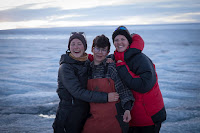
Liane and Rey happy (left), ESR's Team (right). Photo Laura Halbach

Last evening on the ice. Photo Laura Halbach

Great team! Photo Laura Halbach

Wednesday, 29 July 2020

Snow to ice transitions

By Liane G. Benning
 
Despite a few days of sleep and lying low, I don’t know how to properly recover from this marvellous and, compared to many international colleagues, unique opportunity that we were awarded. Against all odds and with preparations and shipments that could have been for nothing, in the end the team made it onto the ice and we managed to carry out a glorious (and at times harder than expected) 3-week field season in the summer of 2020 in Greenland. 
 
This success was an enormous team effort and as Martyn and Alex already mentioned it is all down to the 3 young ESR’s (Eva, Laura and Rey) and to Lasse (our camp manager and all round fixer par excellence) as well as the help of the local pilot crew around Pilu from www.sermeqhelicopters.gl that it all worked out in the end.
 
We are all safely back now. Our travel to Greenland was preceded by an individual pre-departure Covid1 SARS CoV-2 test, if required the 5-day Greenland quarantine and an antibody test on the ice (thanks Alex). While on ice and away from ‘the world’, we felt safe and that the ‘real’ world was far away and COVID19 became almost irrelevant; viruses were only a part of the microbiome that we studied and only an issue in our snow and ice samples and not in/on us. 
 
We had a fabulous – yet at times tough time - strong winds and way, way more rain than we wanted is just one part of the story. We managed to do fabulous science, perform complex experiments, do in situ measurements and collect snow-ice core transitions – all stories that the ERS’s will tell in their own time. We had a well working camp with great food and high spirits even in the most dismal times and a team that I would not exchange for anything. Thanks all !
 
For me scientifically it was also a perfect start and snow-ice darkening transition season. Based on our work at S6 during Black and Bloom, I was almost ready to maybe accept that snow algae are less of a player in the Greenland darkening game. Alas, this season restored my faith in snow algae and their crucial role in the melt enhancing and albedo lowering processed on Greenland. We caught an ideal snowy start (crevasses notwithstanding), with plenty of red snow algae patches all over our camp and work area; with time, melt proceeded as expected and with the rain and strong winds some of these red snow algae patches melted away and transitioned, over the 3 weeks, into dark, ice-algae dominated surfaces; yet some red snow algae fields still persisting until the end. We also saw during our dash to QAS-U that red snow fields were everywhere; even Pilu, our helicopter pilot said he sees them all the time when he flies over the ice sheet. We even saw them at depth (but that is another story); thus, my beloved snow algae are still in the game; phew….

Flying over the dark ice of South Greenland reveals how albedo changes fast during melting

These snow-ice transition processes that we closely observed and lived through this summer were part of our Deep Purple hypothesis, yet they turned out to be way more fascinating than we all assumed. Melting, enhanced and highly affected by rain and wind, gave us even more insights into what we don’t know and how we need to proceed if we want to disentangle the mechanisms and roles of the individual components in this complex, ever changing system; this field season also showed us a likely scenario of ‘what is to come’ in many other areas in Greenland and the Arctic. It showed us how little we understand these fast changing supraglacial systems, where darkening is not just unavoidable but governed by a very complex, highly logical and tight interplay between physics (hydrology) biology (microbes) and chemistry (minerals and soot) that we still have to decipher.  
 
Living on ice and doing science on ice has led to many funny stories and the videos and photos are plentiful and these will emerge slowly in subsequent blogs. Below just a smidgen of those I took.

The top of the ice core is full of dark material that consists of minerals and many many ice algae that change the watering crust

Blue ice coring with a blue ice corer ;-)

A happy filtration tent (note expert tables made by Lasse Deng) and with Laura Hallbach, Alex Anesio, Eva Doting and Rey Mourot all stressing our solar array with many pumps running simultaneously