Monday, 12 May 2025

Svalbard February 2025 – In a world of ice and snow

By Mirjam Paasch

28.01.2025 – A little less than 2 weeks to go and we finished packing all the laboratory equipment we need to take to Ny-Ålesund, Svalbard. The excitement rises the closer we get to our departure to this distant island covered in ice and snow. But from the beginning: I started my PhD at GFZ Helmholtz Centre for Geosciences in Potsdam, Germany not even a month ago, in the middle of the preparations for the planned field trip to Svalbard in February 2025. My PhD is part of the European Research Council ERC-funded DeepPurple Synergy grant. This will be my first ever polar field work!

Most of the heavy equipment was sent to Ny-Ålesund before Christmas, so we can travel lighter with only our backpacks full of warm clothes and a few last crucial consumable items. “We” is a small team of four people: Christoph, post-doc at GFZ and the leader of the expedition; Liane, our professor; Anirban, a PhD student in his second year and myself, the newest member of the GFZ Interface Geochemistry team. Our goal is to find glacier ice algae, tiny single-celled algae, in the ice under the snow on glaciers surrounding Ny-Ålesund. In the summer, these algae color glacier surfaces dark brown to purple – thus the DeepPurple project. However, what these algae ‘do’ in the winter and how they survive the cold and darkness is currently unknown. Between testing methods and reading papers, I’m now counting the days until our flight to the far far North, already dreaming of freezing winds, deep snow, and polar lights.

09.02.2025 – We reached Longyearbyen! Flying in-between steep mountains with weirdly flat tops, the city stretches out as an accumulation of houses in a valley shortly before we land. At the baggage belt, the first stuffed polar bear greets us. The shuttle bus to town is packed full of people, unexpected in this place so far from everything. A sign shows that we are now closer to the North Pole than to Hamburg, which is an incredible feeling. The landscape only exists in white and shades of grey, like natural color ceased to exist, the only yellow and red coming from the lights of the ‘city’. It’s 12 pm, yet it feels like late afternoon with the dim light and thick clouds, the sun will not raise above the horizon for eight more days. The hotel that we check into is cozy and full of old pictures of mine workers but the most impressive thing about the low buildings is the windows half covered in snow; drifts carried by the wind building up in front of unused doors. We are lucky as the weather is calm now, and the air temperature is not too low, though a little wind is enough to make the cold bite into hands and nose. We walk the short distance to the town center and have lunch in a lovely café before walking down to the seaside, where all you can hear is the wind and the small waves gently splashing while rolling to shore. The roughness of the landscape makes me feel tiny and unimportant and makes me remember that outside of Longyearbyen, the forces of nature take over, unimaginably stronger than me. There is not much more beautiful for me than the simplified, harsh landscape of the Arctic and here I am, standing on this island 1000 km from the North Pole, a dream come true.

Looking down to the fjord of Longyearbyen and the mountains on the other side and our hotel, covered in snow drifts but very cozy inside. Copyright Mirjam Paasch.


10.02.2025 – The ‘expeditional’ character of our travel becomes obvious. While the weather was stable in the morning, colder than yesterday but only very little wind, this turned very fast into a proper snowstorm in the early afternoon. After waiting for an hour at the airport, our flight to Ny-Ålesund was canceled for today, no wonder when looking at the menacing dark grey wall coming towards the city. So, back to the cozy hotel we have an afternoon for free use, spending some time in the museum and then on a windy walk through the town. In the darkness illuminated by streetlights and a few cars, the wind gusts whirl around snow, no way to tell if it came from the sky or from the ground. The small path to the hotel is swallowed by centimeter-thick snow drifts and the mountains around that we still saw in the morning disappear in the clouds and haze of snowflakes coming from all directions at once. Hoping for good weather tomorrow so we can finally arrive at our destination!

11.02.25 – We fly to Ny-Ålesund in a tiny propellor plane with two rows of seats. My heart is beating fast when we take off and the landscape stays beneath us. The sky is clear, almost no clouds and we fly much lower than lager passenger planes. During the short ~ 25 min flight, I can’t take my eyes off the landscape: endless white plains that look like no living being ever walked over them, sharp peaks in between (now the German name of the island, Spitzbergen, makes sense), turquoise glacier ice with deep cracks at the edges of dark fjords, and, every here and there small icebergs drifting around on the water.  The science village Ny-Ålesund, with its colorful wooden houses, appears on a flat area next to the shore. When we land, a van picks us and our luggage up, and we drive to the main service building where we are greeted by the AWIPEV research station leader Alex. For the rest of the day, every minute is filled, from introduction to the station, getting to know the two AWIPEV station engineers Celas and Thomas, and snow scooter training to dinner followed by polar bear safety training. In between, the view from every window takes my breath away. There is only a little snow covering a thick ice layer from the last warm days with positive temperature and rain (in the beginning of February at 79° North!). Still, the white cover allows us to see the landscape illuminated by the moon. And in the evening at the shooting range we are even treated to some northern lights!


Inside the tiny plane. Copyright Mirjam Paasch.

Views from the plane on Ny-Ålesund and the glacier Kronebreen at the end of Kongsfjorden. Copyright Christoph Keuschnig.

Our location on Svalbard (yellow star, map from Google Earth), Ny-Alesund (blue star) and the two glaciers we visited for sampling: Austre Broggerbreen (green star) and Midtre Lovénbreen (orange star), map from the Norwegian Polar Institute (NPI), website: https://npolar.no

13.02.25 – After finishing all administrative, introductory, and training courses on the first day, the next two days are for fieldwork. We are on our second tour to Austre Brøggerbreen, this time with the whole team accompanied by Celas from the AWIPEV station. We found our sampling spot yesterday by drilling some test ice cores and looking for darker layers in the ice indicating the presence of biological material – basically last summer’s bare ice surface. Today, the temperature is below -10°C, so we try to keep the time short during that our hands are out of the thick gloves to handle the ice cores. Humidity from my breath freezes on hairs that escaped from my balaclava, on the outside of the scarf, and even on my eyelashes. While Anirban and Christoph core the ice cores, Liane and I kneel in the snow, photographing and measuring the position of different layers in the ice, cutting the core into pieces, and packing the samples into sterile plastic bags and jars. Celas walks around, taking over the polar bear watch for today and in between taking pictures of us in the snow, probably looking like kids in our thick overalls digging holes in the snow. For lunch I eat my first frozen sandwich, but the view makes it all worth it. When the snowmobile sled and the trunks of the scooters are full of ice and snow samples, we drive back down to the village through the small moraine hills at the end of the glacier, with the disappearing light painting the sky pink.

The Team on Austre Brøggerbreen after a successful 2nd day of sampling. From left to right: Anirban Majumder, Liane G. Benning, Mirjam Paasch, Christoph Keuschnig. Copyright Wenceslas Marie-Sainte

One of our ice cores with a visible dark biological layer. Copyright Mirjam Paasch. 

15.02.25 – The days start to blend into each other. Two days of fieldwork are followed by two days of processing liters and liters of melted snow and ice for later analysis in the lab. The hours in the lab are only disrupted by the regular meals in the service building and a walk to the harbor and along the shore close to the village, where the water is incredibly clear, and a thick layer of ice covers the beach and first meters of sea floor. One of the last houses on the way down to the fjord is in the summer a bar where people are sitting outside in the never disappearing sun – not really imaginable with all the snow and ice around now. In the afternoon I am lucky enough to join a ski tour along the shore towards the small hut Gåsebu. While pushing my cross-country skis forward, I try to convince myself that this is really happening. The light in the afternoon is especially beautiful, coloring the sky in orange, pink, and purple and there are pancake-shaped pieces of ice floating on the small waves. We start a fire in the small oven of the hut, filling the room with warmth while drinking tea and eating some snacks. While the guys stay in the hut overnight, Anna and I ski back to the village for dinner, enchanted by the deep purple color that the sky has tonight. In the darkness, we use our headlamps to find our tracks in the shallow snow. On the brightest setting the cone of my lamp illuminates the meters in front of me but beyond this, the landscape disappears almost completely. Now and then we stop to look around us, both happy that we don’t have to walk alone and relieved when we make it back to the safety of the village, my heart filled with the wonderful experience.

At the beach of Ny-Ålesund during a lunchbreak walk. Copyright Mirjam Paasch.

At the beach of Ny-Ålesund during a lunchbreak walk. Copyright Mirjam Paasch.

17.02.25 – After finding a path to our second glacier - Midtre Løvenbreen - with the snow scooters yesterday, we are back today to collect ice cores with as much biomass as we can get. On the way up we saw seals on the beach of one of the small islands in the fjord. The weather is wonderful again, blue skies and the first rays of sunshine color the peaks on the other side of the fjord orange. The sun will not return to the village of Ny-Ålesund for almost another month, still, it is very bright outside, due to the scattering from the snow, and by now we have an almost normal day length. After finishing our work for the day, we stay on the glacier for a while, just taking in the view: the steep drop of the glacier below us with snow scooter tracks cutting through the white, the rippled plain further down with spots of grey and black that ends in the steel-blue of the sea, the peaks rising from the water on the other side of the fjord with endless white glaciers in the valleys and green-blue ice where the glaciers meet the sea, above all the endless sky that is purple above the mountains, then turns pink and orange before the light transparent blue of winter. 

First sunlight on the mountain tops. Copyright Mirjam Paasch.

On the way back to the research station with the scooters full of samples. Copyright Mirjam Paasch.

20.02.25 – The last days were quieter but busy, spending most of the time in the laboratory rooms melting and filtering all our samples, looking at them under the microscope, and performing the first measurements to get a first impression on the state of the algal cells. More time-consuming experiments and measurements will be performed back in Potsdam, for example to analyze the community of microorganisms in our samples and the available nutrients that they could use as energy source. In between we have smaller activities, like a science talk to the public in the village and launching one of the weather balloons. Today the sky is covered in low-hanging clouds and in the afternoon, it starts to snow, huge flakes that cover the village in silence. In the evening, we visit the dog yard, where some huskies that belong to a few of Ny-Ålesund’s inhabitants live. They are very cuddly, most of the time two or three try to climb on my lap at the same time while I’m kneeling in the snow, or lay next to me, exposing their belly as if they would not even feel the -15°C through their thick fur. With my heart full, I return to the last bits of packing, we have to fit all our collected samples into the big ice box, hoping that we make it home to Potsdam quickly enough to prevent them from melting.

Purple sky on one of the evenings. Copyright Mirjam Paasch.

Someone ever build a snowman inside? Copyright Mirjam Paasch.

Cuddles with the cutest dogs. Copyright Christoph Keuschnig.
.
21.02.25 - After breakfast, we take one last walk to the harbor, and then suddenly our time in this magical place is over. The wind is bitterly cold, and snow swirls around on the street. Despite the cold biting at my cheeks, I don’t want to leave; this frozen place has stolen my heart. There’s something about the quiet and the expansiveness of the landscape - harsh but with soft colors, wild and beautiful. And the people who welcomed us warmly, spending either short or long periods here to facilitate our research or pursue their own. When the small propeller plane takes off, the landscape is visible only for a moment; the village shrinks away and the mountains rush past, and then we find ourselves above the clouds. Perhaps this makes saying goodbye to this special place a little easier, which hopefully is more like a “See you soon”. We depart with a considerable number of samples waiting to be analyzed in the coming months, hopefully providing us with new insights into the microscopic life on glaciers after a long and dark winter. And with phones full of pictures and memories of moments I will never forget

Thank you to Liane, who brought us to Ny-Ålesund, Anirban, and Christoph for making such a good team, and the AWIPEV staff Alex, Thomas, and Celas, for all their help.

The AWIPEV blue house, our home for 10 days. Copyright Mirjam Paasch.

Hello and Goodbye in the lobby of the Kings Bay service building. Copyright Mirjam Paasch. 

Last view on Ny-Ålesund.  Copyright Mirjam Paasch. 


Tuesday, 24 October 2023

Exploring how Deep Purple results can be communicated using a dialogue-based approach

In January 2023, we packed a lot of warm sweaters and settled in Sisimiut, the second largest town in Greenland. We wanted to explore how the research of the Deep Purple Project can be communicated using a more engaging dialogue-based approach instead of the common format of a lecture during which it is only possible to ask a few questions after a PowerPoint slideshow. 

During two months, we lived, worked in Sisimiut and participated in the very active local community. During our stay, we transformed a PowerPoint presentation by Alex Anesio into an interactive installation, which was based on different images from the Deep Purple Project. 

With the installation, we wanted to initiate and facilitate dialogues about the research of the Deep Purple with the citizens of Sisimiut. In February 2023, we exhibited our installation at the Ilisimasat Science Festival, and at the local upper secondary school, GUX, in Sisimiut. We had many insightful dialogues about ice, ice algae, albedo, and life with citizens (see picture below). Prior to events, we could not foresee what would happen, or if anyone would talk with us, but there was a great interest, and we learned a lot from dialogues we had. 

We are very grateful for all the people participating and who we have met along our way during the process of writing our thesis.


One of the activities within the installation was a large image of Greenland which people could paint on using their fingers and purple paint. 


Persons gluing and arranging images within the installation. 

Friday, 22 September 2023

Looking for the Window during Fieldwork

DEEP PURPLE postdoc Katie Sipes has written a blog post for the Cryospheric Sciences (CR) Division of the European Geosciences Union (EGU), reflecting on the 2023 DEEP PURPLE fieldwork in Greenland:

https://blogs.egu.eu/divisions/cr/2023/09/15/looking-for-the-window-during-fieldwork/ 

On the ice sheet, the topology is carved with purple ice algae. Persons pictured: Alex Anesio, Christoph Keuschnig [Credits: Katie Sipes]


Monday, 23 January 2023

Discovering the world one molecule at a time: 42 scientists on a metabolomics adventure


DEEP PURPLE PhD student Elisa Peter has written a blog post for the European Association of Geochemistry, reporting back on her experience attending the EMBO Practical Course on Metabolomics Bioinformatics for Life Scientists in Wageningen, the Netherlands:

https://blog.eag.eu.com/news/discovering-the-world-one-molecule-at-a-time-42-scientists-on-a-metabolomics-adventure/

Tuesday, 5 July 2022

Diversity in action

By Rey Mourot 

How going to the Greenland Ice Sheet to study glacier microbial communities, their impact, and their diversity … teaches us quite something about our own! 

“Do we have everything ?”

The kitchen is full of stuff as I’m making sandwiches for the day on the ice sheet. Gluten-free bread and lactose-free spread cheese for Helen; this amazing vegan-feta thing for Katie, cheese and all the crappy food that fuels my motivation daily … thanks god Liane eats pretty much everything. Sandwiches packed, and here we go. Helicopter, ice sheet.


Helen, our GFZ postdoc. Fascinated by eukaryotic algae, she’s the “culturing” part of our team – although, as she says, she’s not able to keep a pet plant alive 😊

While they dig snow pits, the American Katie gently pokes on Helen’s British/Scottish accent and they try to imitate each other. I’m coring in silence, enjoying that my French accent is not brought up in the conversation. Liane is a few meters upwards from us, collecting air and snow samples; as a “European citizen” as she likes to say, her accent is from everywhere and nowhere at the same time.
  

Liane, GFZ Professor and the PI on this trip. Here to supervise, keep us alive and sample aerosols; although not necessarily in that order. Picture by Katie Sipes.

And as it should be, there’s no fieldwork in Greenland without Greenlanders – and our helicopter pilot Pilu, from Sermeq Helicopters, who has seen it all and way too cool to describe, completes our joyful team of small human-ants on the ice. In-between the jokes, our little fieldwork is going smoothly.
 

A view of our office on June 4th. 

Although this year we are only dashing in and out of our field site, I remember our long camping fieldworks of the two past years as a founding experience when it comes to learning from others and about ourselves.

On the ice sheet, isolated from the world and our dear and otherwise ever-present web connections, we quickly get to know each other by sharing common scientific interests and goals, but also by building an everyday life together – cooking, cleaning, doing the dishes, securing the camp, informing one another about the new crevasses that can be spotted around, how to flush the most correctly our natural waste. Camp mood and closeness is important both for the productivity of our sampling and our survival; and we all quickly learn the needs and quirks of each of us that need to be fulfilled to keep each member of the team happy.

Our DP 2021 field camp after the mist suddenly fell on it … speaking about extreme environments.  

This one works in the evening but will be late at breakfast; this one’s mental health depends on a constant supply of hot chocolate, this one needs to snack regularly or their mood will suffer, this one need more access to the communications to the mainland at the moment, this one will take afternoon naps, this one gets cold faster. Although we are all self-preserving, it actually becomes part of the routine to check on each-other, especially in an extreme environment. After all, several studies indicates that mutualistic groups have a higher chance of survival than groups composed of individualistic members.

Katie, postdoc in bioinformatics, the Aarhus part of our team, swimming among the icebergs in the harbor – among many other crazy things she does daily.

We easily adapt to our important diversity by giving our members maybe not the exact same things; but rather, what they need so the team functions at best. I sometimes wonder why this kind of diversity just functions so well for us, but the fieldwork world is still barely able to make gears that are safe and practical to use for everybody, pants half the population wouldn’t need to put down to their knee by a shitty weather to pee, and just, in general, space for all that do not correspond to the dominant idea of the explorer. 

In this bright month of June, far away from those considerations, our little four-people team is working to perfection; flowing smoothly between our differences of tastes, cultures and rhythms, as we learn to know each other’s qualities and quirks.

And, of course, the real stars of our fieldworks … these aggregates of cells and minerals trapped under the snow layer since September, and that we managed to reach to study them! 


Monday, 4 July 2022

DEEP PURPLE post on Department of Environmental Science LinkedIn

Snow isn’t exactly welcome on this Arctic expedition. 

Last week, Martyn Tranter, Ate Jaarsma, Shunan Feng, and Lasse Twiggs Degn set off on their summer fieldwork – the first of 20 who will make the journey this season. Traveling up to the north of Greenland with a portable research base is no mean feat – they must transfer 10 tons of equipment by barge, and helicopter to set up camp on the ice. It’s not just laboratory facilities either - sleeping quarters, toilets, a kitchen, and power sources need to be in place to support the altogether two-month long stay on the ice.  

But setting up camp in the wrong place could be disastrous. Snow in this case can dangerously conceal deep crevasses in the ice, which can quickly grow with glacier movement. Finding snow on arrival means that the team have been on standby in Ilulissat for a few days, and are in good spirits while they wait for an improvement in conditions so they can set up camp safely. If this drone footage captured by Shunan Feng is anything to go by, then at least it’s not a bad place to wait! 

Once the camp is established, the group will start their investigations, collecting data and studying the biology and chemistry of the glacier surface, and how this can affect the darkening and melting of the ice as part of the Deep Purple project. Read more about Deep Purple on the project website here: https://lnkd.in/eAtYzHvc and follow them on Instagram for some more insights from the team https://lnkd.in/ejx8Xbup. Deep Purple is funded by the European Research Council (ERC).

The original post can be found at https://www.linkedin.com/posts/envs-au_drifting-through-ilulissat-no-audio-activity-6949626298927333376-_TRT 

Wednesday, 1 September 2021

From 100 to 50 and 50 to 100

by Alexandre Anesio

The previous blog by Liane G. Benning clearly described the journey of trying to put together a massive and ambitious fieldwork programme for the Deep Purple project, going from the microscopic scale to remote sensing information to demonstrate the impact of ice algae and other impurities on the darkening of the ice, their controls and dynamics. A bunch of names from the brave team will be mentioned here and you can learn more about the team members on our “team” page.

No doubts, we started in a very high mood. However, as team 1 (Principal Investigator Martyn Tranter, Lasse, Rey, Joe, Ian, Eva, Shunan, and Lou) started their journey from Denmark on the 1st of July and began the process of setting up the camp, they were hit by a number of obstacles. The weather was far worse than predicted, delaying helicopter trips to the ice camp from the lovely Greenlandic town of Qaqortoq (https://visitgreenland.com/da/destinationer/qaqortoq/). Corona just started to hit Greenland, which had faired very well until ca one week after we arrived. We had to separate our teams between vaccinated and non-vaccinated members of the group, reschedule the science programme and wait for good weather. The task of setting up a camp for ca 16 people at a time on the ice was more challenging than anticipated. Team 2 (myself, Marie, Ate, Frederik, Chris, Pamela and Leeds University beloved collaborator Jim McQuaid) arrived on the 8th  of July with half of team 1 still in Qaqortoq. It took five days before we were all on the ice, but we had to leave Martyn Tranter behind in Qaqortoq to serve as a very needed organizer and local fixer on the ground, securing communications between ice and civilization, sending of the samples back to Denmark/Germany, organising flights and all sorts of things (even buying 15 rain ponchos that turned out to be a quite nice addition to keep the team on the ice dry).

Deep Purple camp when it was at its max capacity. Photo Alex Anesio

Team 3 (Principal Investigator Liane G. Benning, Helen, Elisa, and Laura Perini) arrived on the 12th of July to Qaqortoq but only managed to get on the ice ca 5 days later since Qaqortoq went into lockdown. Meanwhile, Teams 1 and 2 had just experienced 52 mm of rain on the ice in a 24 h period. Within just one 1 h of Team 3’s arrival, another 47 mm of rain fell. Considering the conditions (both weather and corona uncertainty), Team 4 had to cancel their travel plans, but their science plans were re-distributed between us to ensure all science was carried out. This left us behind time-wise, but then a spell of good weather hit, and that, coupled with great spirits in the team and the desire to get a lot of work done, was just what we needed.

A massive transformation on the ice was now happening in front of our eyes with the ice algae blooming. The rain had seemed to wash microbial cells together with impurities, but a few days of dry weather in the middle of the summer darkened the ice at incredible speed. At this point, the camp was running like a watch; carnivores were eating like vegetarians, freezer, fridge and -80 degree freezer were getting full with samples, the solar panels were providing all the energy necessary to fuel all sorts of equipment, and our journalist and TV visitors managed to make it all the way to the ice sheet (no names mentioned yet ;-)). All this happened as we received news from the civilization that Greenland was having unprecedented amounts of rain and the IPCC report was released, demonstrating the urgency of more understanding of feedback mechanisms between different stressors and fueling the young scientists in the project with a clear sense of purpose.


First lot of -80 degree samples for omics and pigments arriving with teams 1 and 2.

Slowly, parts of Teams 1, 2 and 3 left this year’s field camp, having done their jobs brilliantly. On the 6th of August, I arguably had the most glorious day of my scientific life. The final team of six scientists (Lou, Shunan, Liane, Elisa, Laura P, and myself) and our field logistics whizz Lasse woke up to blue skies. As luck would have it, that day satellites were passing above our location and we had a full day collecting data from the microscopic scale to cm and then meters to make the full connection of what we see on the ground and what satellites  observe from the sky. The ice algae were in full bloom and the ice surface was full of very active ice algae. We walked about 20,000 steps, collecting pictures of the ice, spectral signatures and samples for all sorts of omics. Flights with the drone matching the satellite passing were also done. It was a tiring day that went on throughout the night, with additional midnight sampling to check how the ice algae behave when it is dark. Our luck continued during the few hours of darkness, as a rare event of northern lights put icing on the cake  ̶  what a fantastic day.

Left: Ice surface (tens of cm scale). Picture taken from 1.7 m distance from the ice. Photo Alex Anesio

Right: Ice surface picture taken with a handheld microscope (mm scale). The pigmented ice algae is very abundant on the ice (example of a filamentous algae shown by the arrow), which essentially explains a lot of the darkening of the ice. As the ice becomes darker, more melting occurs. Photo Alex Anesio

After that, it was time to start the long process of decamping. Not easy, but it went super-smooth. Almost 4 tonnes of science and camping gear had to be removed from the ice, dried back in Qaqortoq and carefully packed into a container for transport back to Aarhus University at Risø and the German Research Centre for Geosciences in Potsdam labs. Most importantly, the ambitious plan set at the beginning of the project paid off. We shipped back 100 kg of frozen (-20 degrees) samples, 150 kg of cold samples and 6 cryoshippers (-80 degrees) full of samples for metabolomics, metagenomics, transcriptomics, proteomics, pigments, viruses, etc. Lots of experiments were run on the ice to investigate how ice algae respond to various physico-chemical conditions and how they interact with the other members of the microbial community, and a range of bacteria, viruses and fungi are being cultured with novel approaches. Terabytes of spectral data (drone imagery and ground truth measurements on cm scale) are now available.


 Day or night, dry and wet, Deep Purple never stopped for about 5 weeks on the ice. Photo Alex Anesio.

I could not have had a better field season. A very resilient group of young scientists went through rain and pain and did everything they had planned. Deep Purple transformed wet misery into opportunity. Climate change will likely bring more wetness to the ice sheet. Scientists in Deep Purple did not hesitate to keep collecting samples in the rain, and this might give us a peek preview of how microbial communities behave in the rain on the ice; how the weathering crust is changed in the rain; and how fast it recovers after just a few hours of sun. All these data are fundamentally important for the parametrization of ice albedo into future climate models.


Principal Investigator Alexandre Anesio with Lou, Marie and Laura Perini just after lots of rain and enjoying a gift from the skies.


Another gift from the skies during fieldwork. Photo Alex Anesio.

I just want to finish to say a huge thanks to this amazing group of young scientists, wonderful friend and stimulating PIs and flexible supporting project managers, for their friendship on the ice, resilience, enthusiasm and hard work and for making me eat less meat, although I am not sure I will be able eat lentils again for at least 6 months.


Laura Perini and Alex Anesio finally enjoying a meal with meat without having to cook lentils.


Self on the last morning before leaving the ice. So much easier to decamp on a dry day. Photo Alex Anesio.

Tuesday, 6 July 2021

DEEP PURPLE PI musings – how a bunch of cryo-minions study ice darkening (or are we mad to put 27 people in a tent camp on the Greenland Ice Sheet in 2021?)

 by Liane G. Benning

As one of 3 @DeepPurpleERCSy PI’s I can only say that I am extremely glad that the summer 2021 DEEP PURPLE field season has finally started! 

In 2020 we had 7-8 people in camp and did some great science. We knew that in 2021 we would hire a whole slew of new ECR’s, who will shape the science focus for the rest of the DEEP PURPLE grant duration. We also hoped that maybe humanity would behave and COVID would not still be with us in the summer of 2021, but hope is a good thing.

Nevertheless, in October 2020 we decided to have a ‘bigger, stronger and more ambitious’ summer 2021 season. Deluded, I know, but we wanted to let a large team of eager scientists loose to test our hypotheses and fulfil the science dreams for which @Alex, @Martyn and I (@Liane) were awarded the @ERC Synergy grant DEEP PURPLE.  

Below some of my thoughts of how a bunch of DEEP PURPLE ‘minions’ planned and organised a massive summer field season. 

Looking back, I often wondered what made us believe that it would be a good and feasible  idea? The answer is actually rather simple!  We had no choice! 

We hired a fantastic and highly diverse group of ECRs from all over the world and each and every one of them came up with brilliant fieldwork plans to address various aspects of our research questions … so we simply had no choice. We had to do it !!

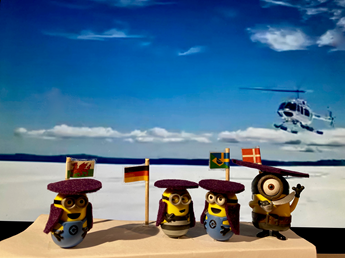
Figure 1 DEEP PURPLE ‘minion’ PIs: (from left to right) our supreme Welsh primo leader Martyn Tranter, the unashamedly European, yet of German descent puzzle master Liane G Benning, the Brazilian/Swedish superstar Alexandre Anesio and our Danish, sword wielding camp master Lasse Twiggs Degn in the appropriate DEEP PURPLE PI attire

Figure 2 The multinational and diverse DEEP PURPLE ESR and PI team are ready to get going for the 2021 field season in Greenland!!

We started with plan A, changed that to plans B, C, D ….. and after ~ 8 months of discussion and changes we are now at plan Q or so. We all know that once on the ice the conditions will force us into plan Z+++++, but we are all prepared for that (well almost all !).

So how did we manage to pull it off? 

Well, we have not yet, but DEEP PURPLE team 1a (of 5 teams) is already in Greenland and team 1b just departed Copenhagen airport. Teams 2, 3, 4 and 5… will follow in 5,10…etc days.  

Part of the DEEP PURPLE team 1 did a reconnaissance flight yesterday to establish base camp location and to test field communications.

Figure 3 (a) Reconnaissance flight was used to establish base camp location for DEEP PURPLE 2021, test drone and communications via Garmin and Satellite phone - all worked and we are ready to go (map sent as text via Garmin by @Rey Mourot)

Figure 3 (b) Selfie of the reconnaissance crew (Joe Cook, Martyn Tranter, Eva Doting, Rey Mourot and Pilu (pilot from https://www.sermeqhelicopters.gl/) at the DEEP PURPLE 2021 field base camp enjoying the sunshine and assessing conditions for deployment. (photo copyright @Rey Mourot)

Figure 3 (c) Drone image of DEEP PURPLE base camp area in S Greenland; note helicopter at bottom left side for scale (photo provided by @Joe Cook)

So what did it take to make this happen? Here some of my thoughts. I am sure Martyn, Alex, Lasse and the whole team have their own stories.

It all started in our weekly DEEP PURPLE PI discussions. We first agreed on the maximum number of people to have in camp at one time; we started with maximum of 10 people, raised it to 12 … and ended up with maximum 16 people in camp, a total duration of the field season from door to door of 50 days and a total of ~ 570 people days in camp. Let the science rule!!. 

With such a big and complex camp, there were many possibilities of how to achieve / manage this, giving everyone enough time to fulfil their science objectives, while remaining within the camp size limits and allowing for changes due to weather etc etc. Planning such a camp needed several puzzles to be solved simultaneously, some of which are briefly shown below. Luckily, having a somewhat anal but organised puzzle-loving German among the PI’s was not a bad thing (the alternative would have been a Welsh or Brazilian ‘organised’ camp!)

So, in early 2021, I started assembling a constantly changing plan and after many, many, many, many, permutations / discussions / changes the current plan foresees 6 consecutive, yet overlapping teams, who will spend a total of ~ 570 people-days in camp.

Figure 4 How to put 27 people in a DEEP PURPLE camp for field work, while not surpassing 16 in camp but giving all the needed on-ice time for the research (Liane G Benning, puzzle no  1 version xx)

To do our work on the ice, we will have 4 lab tents filled with loads of loads of science gear from microscopes to drones and from pumps to pH meters, cryp-shippers etc. etc. (~ 90 boxes and cases worth of it). All this will be powered by a big solar array and two wind turbines. We also thought hard about the fact that our ~570 days on ice also equates to ~ 570 ‘crap’ days on the ice, so our Teams WikiCrapia channel had some – to say the least – interesting suggestions/discussions on this subject.  

Figure 5  To allow all our DEEP PURPLE samples to be preserved well we came up with a rotating cryo-shipper schedule (Liane G Benning, puzzle  no 2 version xx)

Finally, in camp, each team member will sleep in their individual tent, but we will all cook and eat together in a large mess tent in which we will consume ~1000 kg of food. To make the camp run smoothly, besides tent relocations, day-to-day logistics and keeping power going etc., we also have a camp ‘chores’ rota with daily-designated duties for everyone from preparing breakfast or dinner, washing dishes, fetching water and all the way to the dreaded ‘crap’ job!  Ignoring or not doing ones scheduled chores results in automatic assignment of additional ‘toilet-cleaning’ duties! Thus I am sure everyone will do their duties 😉.

Figure 6 DEEP PURPLE summer 2021 camp chores schedule (Liane G Benning, puzzle no 3 version xx)

Only fair play and teamwork will make our camp plans possible, but with this excellent team of people we, the PIs, will be able to just sit back, relax and enjoy camp life in the sun with a nice whiskey or gin and tonic while the camp runs itself like a dream and the science happens 😀 

Many more details about how we managed to get here and how we pulled it off once on the ice will come via further blog posts on the DEEP PURPLE website (see already the brilliant RISO ECR preparation blog).  Thus, stay tuned and follow us on Twitter.

Tuesday, 29 June 2021

Fieldwork preparations

By Lou, Marie, Shunan and Ate 
 

Over the last months, we have been busy preparing for this year’s fieldwork, and with that our activities shifted from science to more practical things. Practical things that might be less fun, but certainly not less important than the science we need to do in the field! 


The chance of us meeting a polar bear is very slim, but to prepare for the unlikely the event of one visiting our camp, we needed to complete a rifle training. We had a first theory course during which we learned about analyzing a polar bear's attitude and the subsequent behavior we should have towards the bear. In most cases, polar bears can be scared away and they do not need to be shot. However, it can happen that they are really hungry or protecting their cubs so they adopt an aggressive behavior, and this is why we got a second practical training. We arrived on the shooting range where six printed polar bears were staring back at us. We all learned how to securely manipulate the rifle (always directing at the targets or up in the air), how to load and unload the rifle (Greenlandic half-loading specifically) and how to shoot in different positions from 25 and 50 meters. We all had a really different experience with this shooting training, but we all had in mind that we were about to use highly dangerous tools that hopefully we would not need to use in real life. The shooting range was itself quite impressive, as it is an isolated place with constant shooting noises, and so were the guns as they make noise, they are heavy, and recoil upon firing. The instructor then put us in a stress-situation, where we had to run to the car parking and back and shoot as quickly as possible. Some guns had been sabotaged by the instructor who wanted to test our ability to stay calm, and we all managed to hit the target in time. In the end of the day we left 6 incapacitated polar bear posters behind, and brought home some nervously and emotionally exhausted PhD students. 


We then had first aid training, focusing on the Arctic as it is an isolated place with specificities, e.g. it is impossible to call 112 in case of someone feeling bad there. It was more relaxed than the previous training and nice to try to give CPR to the “little Anne” doll. It was surprising how deep you actually have to press for it to work! And it was a reassuring and empowering experience for all of us that we all know how to perform first aid.


Many hours of work involved getting all of our stuff – which was a surprisingly a huge amount – from the UK and Germany to Denmark and onwards to Greenland. Most of us made daily trips to the basement where more and more packages arrived every day. Steadily our offices became a warehouse filled with cardboard boxes and bubble wrap which were then replaced by plastic boxes as we repacked all of it to fit onto the pallets to then go in a container. 

Eventually the actual warehouse was mostly occupied with Deep Purple materials… Pallet after pallet of consumables, tents, sleeping bags, camping gear, food. Speaking of food, a combined effort made sure that we got some of the most important items included in our inventory. Without (real) coffee, parmigiano, chocolate, etc., certain colleagues just wouldn’t function on the ice. 


More practical jobs followed, like modifying tents, weighing all boxes, packing all boxes on pallets, moving pallets, re-packing them again. Most of us became very proficient with moving pallets around, and the warehouse looked more like a game of tetris. In fact, some of us started dreaming about pallet positions… Two of us also went on a road trip to Aalborg with a van full of chemicals (made it just in time for the boat!). Last but not least, lab tents arrived that had to be set up as a test. After weekends and evenings spent, a full shipping container was finally ready in time to go to Greenland.

In parallel to the packaging tasks is the drone experiment conducted by Ate and Shunan with the help of Lasse. The drone is a DJI M600 Pro and has a payload of 6 kg and will carry the hyperspectral camera on it. The test consisted of several steps. First we practiced our skills in drone simulator. After crashing enough simulated drones, we finally came to the stage of flying the real one. We tested the both the manual and autopilot flight mode. We designed one flight mission to draw a “DP” on the map. Having got the flying part ready, we mounted the gimbal stabilizer on the drone. It will help stabilize the onboard instrument while flying. Eventually the drone is equipped with a hyperspectral camera and a LiDAR onboard. 


We could almost forget that there are still experiments to do, so after the container left for shipping, it was back to polishing protocols, last-minute ordering and waiting anxiously for the last things to arrive. Departure is now fast approaching. Some think there’s too little time, while at the same time it cannot happen soon enough. The massive operation that needed so much preparation is now becoming real! Which still feels a bit unreal. And we’re all looking forward to meet each other on the ice after many online meetings across borders. In the end it was very hyggelig to work long hours in the warehouse together, and we will definitely keep up this work spirit on the ice!